


News Archives
Who Counts in Higher Education?
UC Davis professor Kristine Jan Cruz Espinoza studies how student data and Minority-Serving Institution designations shape visibility and support

Assistant professor Kristine Espinoza’s path to higher education has taken her through science and anthropology classrooms, a state senator’s office, and student affairs in the UCLA Department of Asian American Studies.
Her experiences give her a view of institutions from multiple angles and allows her to shed new light on the classifications they employ to identify and support students. “We operate in a world where we classify things,” she said. “But what happens if we create, remove, or complicate those categories and counts associated with said categories?”
What Teaching Writing With AI Reveals About Student Voice
Two UC Davis Ph.D. students explore what happens when writers compare ChatGPT and peer feedback

After exchanging peer feedback on their first drafts, students in Ana Castellon’s “Introduction to Academic Literacies” class uploaded their work to ChatGPT for another round of feedback. The exercise was part of the statewide research study Peer & AI Review + Reflection (PAIRR), exploring how AI feedback on student writing can help students improve their drafts and influence their decision-making.
Early study results suggest that students found value in combining peer and AI feedback, which Castellon and her fellow writing instructor and Ph.D. student Casey Manogue also observed. But their students also expressed reservations about AI in the classroom, particularly the reasoning behind its recommendations and its tendency to flatten the humanity behind writing.
What Happens to California Teachers Who Start on Emergency Teaching Permits?
New research from Tom Smith and Yiwang Li examines how retention differs by the route teachers take into the classroom

Emergency teaching permits are often seen as a warning sign: evidence that schools are filling classrooms with teachers who haven’t completed their credential requirements. But new research from Drs. Tom Smith and Yiwang Li complicates that picture. Five years after entering the classroom on emergency permits, 62% were still teaching in California public schools, and more than half had earned preliminary or clear credentials.
Smith and Li followed six cohorts of new California teachers across their first five years in the profession, examining how teacher credential pathways related to credential progress and retention. Their study suggests that emergency permits can be more than a short-term response to teacher vacancies. Although their growing use reflects persistent shortages, the permits also provide an expanding entry point into the profession.
Meet the 2026 Mentorship Award Recipients
Two Educators Share How They Support and Learn Alongside Future Teachers

Each spring, School of Education students nominate their resident teachers for the annual Mentorship Award, recognizing the educators who have made a lasting impact on their development. This year’s recipients are Matthew Tealdi, a fourth-grade teacher nominated by Bryan Tan, and Sarah Ronayne, an agriculture teacher nominated by Caitlin Holder.
Building Better Supervision
Annual STENT Conference Addresses a Critical Gap in Professional Development for Teacher Supervisors
 Teacher education supervisors from
across California will come together virtually on July 30
and 31 for the seventh annual Supervisors
of Teacher Education Network Team (STENT) Conference. Led by
Dr. Lisa
Sullivan and colleagues, the two-day event is a professional
development opportunity focused on strengthening supervision in
teacher preparation.
Teacher education supervisors from
across California will come together virtually on July 30
and 31 for the seventh annual Supervisors
of Teacher Education Network Team (STENT) Conference. Led by
Dr. Lisa
Sullivan and colleagues, the two-day event is a professional
development opportunity focused on strengthening supervision in
teacher preparation.
Journaling About Nature and Nurturing STEM
UC Davis Student Group Hermanas Escritoras Lead Fifth Graders in Science Writing

Hermanas Escritoras is a women-led, intergenerational student organization at UC Davis that’s dedicated to bringing full, authentic identities into science writing. Founded in Spring 2024 by a group Chicana/Latina STEM students, the group sought to build community and create space to explore the intersection of science writing, storytelling, art, and lived experience. That mission shaped a recent collaboration with fifth grade students from Marguerite Montgomery Elementary School, who visited the UC Davis Arboretum for a nature journaling activity centered on science and self-expression.
New Study Documents Both Opportunity and Barriers in California Prison Education Programs
Through interviews with incarcerated students, faculty, and program leaders, a researcher examines what supports—and disrupts—college success in prison

As higher education opportunities expand inside California prisons, Joyce Fernandez, Ed.D. ’25, is examining the experiences of incarcerated students pursuing college degrees—and the institutional conditions that shape their ability to succeed.
New UC Davis Research Examines the Future of California Education

A new body of research seeks to inform election discourse with greater insights into local and statewide educational realities. Getting Down to Facts III, a research initiative led by the Stanford SCALE Initiative, brings together leading experts across California to examine the biggest challenges facing schools—and the policies that could define their future.
Sixteen UC Davis researchers contributed eight of the 55 total technical reports, placing their work at the center of educational debates that could influence policymakers, advocates, and voters in the months ahead.
New Study Calls for a More Critical Approach to AI Education

As schools rush to introduce artificial intelligence into classrooms, students are learning how to use AI tools but not to question them. In a new study co-authored by Prof. Jennifer Higgs, researchers examine why writing accurate prompts and identifying AI-generated content isn’t enough to prepare young people for this new era of technology. Learners need to know how to think critically about the social, political, and ethical forces shaping artificial intelligence—and the impact it’s already having on their everyday decisions.
How Parents Shape Early Bilingual Development
UC Davis Researchers Examine How Story Time Improves Language Use

For young bilingual children, learning English often happens alongside something just as important: maintaining the language spoken at home. This language carries family history and cultural identity, and it supports how children communicate, learn, and develop as bilingual speakers.
What Does It Mean to Learn and Teach While Migrating?
What Venezuelan Immigrants’ Journeys Reveal About Learning Beyond the Classroom

Discussions of immigrant education in the U.S. often center on what happens after families arrive in the United States. But that focus misses the critical learning that begins long before arrival and unfolds throughout the journey. The places where immigrants are born and where they teach and learn as they grow, as well as the places they migrate through—and what they experience there—shape their learning as much as their final destinations.
Planting Seeds of Self-Discovery
How Newbery Medal-Winning Author Renée Watson Connects Story, Identity, and the Classroom

Newbery Medal-winning author Renée Watson believes that stories can help young people understand themselves, imagine new possibilities, and listen to the experiences of others. That belief was at the heart of her February conversations with over 1,000 educators, parents, and students at the UC Davis Mondavi Center for the Performing Arts and the Sacramento Public Library’s Tsakopoulos Galleria as part of the School of Education’s longstanding “Words Take Wing: Honoring Diversity in Children’s Literature” program.
How Teachers Are Building Bilingual Students’ Confidence in Their First Language
A federally funded UC Davis School of Education project is supporting this shift in classrooms nationwide

Bilingual students often live in a context where linguistically minoritized communities are associated with inferiority. Prof. Claudia Rodriguez-Mojica and her colleagues seek to empower bilingual educators to challenge these messages instead of reinforcing them. Through a five-year project, Bilingual/Biliterate Instruction for Bilingual Youth, funded by the U.S. Department of Education’s Office of English Language Acquisition, they developed a 60-hour online professional development series for K–8 bilingual educators. Two teachers spoke with the School of Education about the insights they’ve gained after participating in the project.
Triple Alumnus Returns to His Roots to Champion Future Teachers
 Andrew Hood, Cred. ’14, M.A.
’15, Ph.D. ’25, is dedicated to transforming the math classroom
for students and the teachers who lead them. As a UC Davis triple
alumnus who specializes in mathematics education, he has
committed over a decade of research and practice to building more
equitable learning outcomes.
Andrew Hood, Cred. ’14, M.A.
’15, Ph.D. ’25, is dedicated to transforming the math classroom
for students and the teachers who lead them. As a UC Davis triple
alumnus who specializes in mathematics education, he has
committed over a decade of research and practice to building more
equitable learning outcomes.
Now, Hood continues his work at the School of Education as a supervisor for the math credential cohort and program director of the Noyce Teaching Fellowship, a scholarship program that provides professional development opportunities to STEM credential candidates. In these roles, he hopes to empower the next generation of teachers to transform how students perceive, engage, and identify with math.
Noticing What Counts: Rethinking Literacy in Classrooms

UC Davis School of Education Profs. Danny C. Martinez and Alexis Patterson Williams explore the tensions embedded in how disciplinary literacy is defined and enacted in their new book chapter “Noticing for Equity in Disciplinary Literacy Instruction.”
What the 2026 Super Bowl Halftime Revealed About Civics Education
New Study Examines How U.S. Territory Teachers Confront Lack of Representation in the Classroom

When Bad Bunny performed at the 2026 Super Bowl Halftime Show, he brought Puerto Rico and territorial citizenship to the forefront of national consciousness. As viewers across the country debated who and which regions count as American, they revealed a pervasive knowledge gap that begins in civics and history classrooms. Despite the important role that U.S. territories play in American civic life, their histories, political status, and civic engagement often go overlooked in K–12 classrooms.
Waste Audit Brings Science to Life
UC Davis Partnership Shows Students How Everyday Choices Make a Big Difference
 At Marguerite Montgomery Elementary
School, the lunchroom has become an unexpected site for science
learning. A waste audit and lesson series led by parent
volunteers and UC Davis School of Education graduate students is
helping children examine how their daily food and disposal
choices affect the environment. By pairing hands-on investigation
with culturally responsive teaching, the program teaches students
how to sort waste and reduce food loss, encouraging them to
identify as environmental stewards who can bring these lessons
home to their families and communities.
At Marguerite Montgomery Elementary
School, the lunchroom has become an unexpected site for science
learning. A waste audit and lesson series led by parent
volunteers and UC Davis School of Education graduate students is
helping children examine how their daily food and disposal
choices affect the environment. By pairing hands-on investigation
with culturally responsive teaching, the program teaches students
how to sort waste and reduce food loss, encouraging them to
identify as environmental stewards who can bring these lessons
home to their families and communities.
Preparing Teachers With Every Student in Mind
How UC Davis Is Advancing Universal Design for Learning

Kindergarten teacher Paige Hendrix marked her students’ cubbies with personalized nametags for the first day of school. But as students arrived, she quickly realized that most of her class couldn’t yet read their names in print. Rather than rushing to teach letter recognition, Hendrix pivoted, taping photos of each child to their cubby.
“I never want my students to feel excluded,” Hendrix said. “My priority is listening to them and using their feedback to guide my decisions. I looked at where I could change my classroom to make it easier for everyone to learn.”
Bird Watching Takes Flight Behind Prison Walls
UC Davis and Land Together’s Citizen Science Collaborative Culminates in Field Guide by and for Incarcerated People

When incarcerated people engage in scientific research, they do more than learn about the natural world: they contribute knowledge to real-world inquiries and learn how to support their communities.
School of Education Webinar Highlights What Students Need to Access Community College Financial Aid
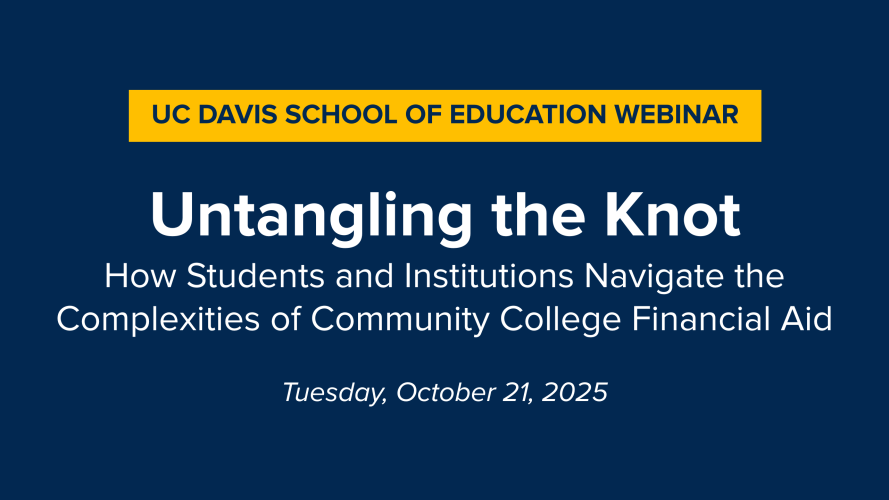
Researchers from the California Education Lab and Wheelhouse: The Center for Community College Leadership and Research took a closer look at enrollment challenges during the UC Davis School of Education’s recent webinar, “Untangling the Knot: How Students and Institutions Navigate the Complexities of Community College Financial Aid.” Panelists drew on statewide high school surveys, community college administrative data, and student interviews to shed light on how the financial aid system shapes who enrolls and who finishes.