
Educational Interventions for Students with Autism,
published as the first in the Autism for Educators
series by the UC Davis Mind Institute, has been released. The
book is edited by Peter Mundy and Ann Mastergeorge. It provides
information on topics related to deepening educators’
understanding of the issues and best practices involved in
education for autism, including practical strategies for
teachers, parents and school administrators.
Purchase the book here.
Excerpt from “Sacramento Area Youth Speaks (And the World
Listens)”
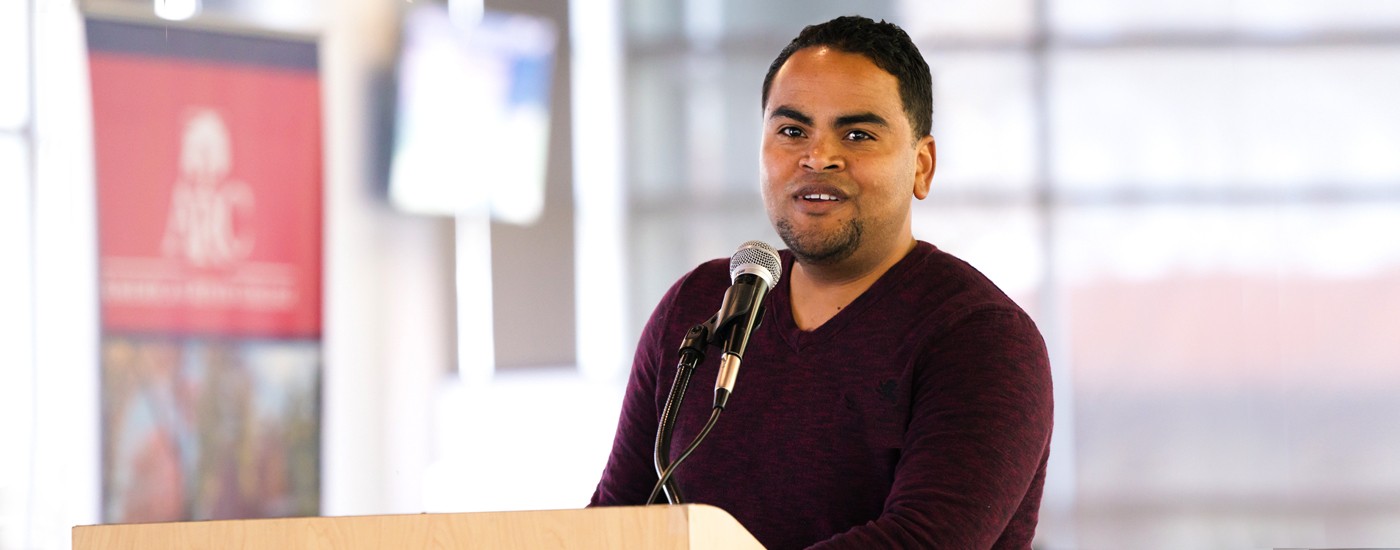
One day in high school, while on a field trip to Sac State for an
African-American student leadership conference [Dre-T] stumbled
upon a Sacramento Area Youth Speaks workshop. He was immediately
hooked.
As the group of teens shouted their poems from every corner of
the room in a guerilla poetry spectacle called Griots (which are
an ancient West African tradition that S.A.Y.S has adopted)
Tillman was captivated. “I’d always been hungry for knowledge,”
he explained, “S.A.Y.S had the food for the thought I was
starving for and they knew I was hungry.”
In his op-ed, “Time to rethink what makes a school great, keeps
kids learning,” Dean Harold Levine argues that engagement and
keeping kids in schools must be at the top of our list for what
determines a successful school. Read the piece at the
Sacramento Bee.
PhD student Kathryn Hayes has been named to serve on the 2012
David L. Clark National Graduate Student Research Seminar in
Educational Leadership and Policy. A number of doctoral students
were nominated this year from universities in the U.S., Canada,
and abroad. 40 were invited to participate. The David L. Clark
National Graduate Student Research Seminar brings together
emerging educational leadership and policy scholars and noted
researchers for two days of presentations, generative discussion,
and professional growth.
The 32nd Annual Seminar in Educational Administration and Policy
will be held in Vancouver, British Columbia on April 12-13, 2012,
in conjunction with the annual conference of the American
Educational Research Association.
Tom Timar, professor and faculty director of CAP-Ed, and Julie
Maxwell-Jolly, managing director of CAP-Ed, are the editors of a
new book, published by the Harvard Education Publishing Group:
Narrowing the Achievement Gap: Perspectives and Strategies
for Challenging Times. The book is available through
Harvard Education Press.
Thursday, February 23, 10:30 a.m., Freeborn Hall, UC Davis
Thursday, February 23, 7:30 p.m., Alumni and Visitors Center,
UC Davis
The morning lecture is directed at students, grades 3-8. It is
held in Freeborn Hall which can accommodate up to 1,400 people.
The evening lecture is intended for an adult audience and is a
more formal lecture with Q & A. It is held in the Alumni and
Visitors Center which can accommodate about 150 people. Both
presentations are open to the public. Tickets are available at
the Freeborn Hall ticket office or at Tickets.com.
Associate Professor of Education and Department Chair, Mount St.
Mary’s College
Thursday, February 23, 2012
Talk: 4 p.m. – 5:30 p.m.
Workshop: 6 p.m. – 8 p.m.
Please RSVP for
the Workshop
In her talk, “Confronting White Privilege: Continuing
Realizations and Growth Opportunities,” Dr. Tochluk will
share her research into whiteness, its meanings, effects, and the
overt and subtle ways white privilege occurs in society, home,
and work.
Co-sponsored by the Committee for Social Justice, School of
Education, Office of Graduate Studies, and the Office of Campus
Community Relations.
The Education Graduate Student Association and the School of
Education hosted “UC Davis 101,” an open seminar for students,
staff and faculty. Learn about how UC functions as a state
agency, how higher ed funding works, the history of UC and how
funding at UC Davis is spent.
A great way to learn more about the UC Davis Teacher
Credential/M.A. program is by attending a Credential Information
Session. Sessions are typically conducted twice per month, from
October to May.
Upcoming Info Sessions for Teaching Credential
All sessions are held in the School of Education Building, Room
174
February 22 – Noon
March 5 – 4:00 p.m.
March 27 – 5:00 p.m.
During the session we will discuss the following topics:
Credential & Masters Program Format
When the year starts; how soon you will earn your credential; how
you move on to the Masters portion of the program
Provide Information Regarding our Prerequisites
How to meet the requirements; how to have a class reviewed to see
if it is equivalent; how to have your G.P.A. evaluated, what to
do if prerequisites can’t be met by application deadline
Information Regarding Required Testing
California Basic Skills Requirement (commonly known as CBEST);
Subject Matter Verification (commonly known as CSET); how timing
of the tests impacts when you should apply
The Admission Process
When is the best time to apply; how to apply; what happens after
you apply
We encourage questions throughout the presentation and provide a
small group format for a Q & A session with faculty/staff at
the end of each session.
Attend a session!
To reserve your space or request more information about the a
session, please email eduadvising@ucdavis.edu.
Although an RSVP is not required, the info session date, time, or
location can change. For this reason, please check back on the
website the morning of an information session to confirm. If you
have submitted an RSVP we will notify you of any changes.
All sessions are held in Room 174 in the School of Education
Building located on the corner of First and A Streets, by Olson
and Voorhies. Please view our map for
specific directions to the School of Education.
“Ready or Not? California’s Early Assessment Program and the
Transition to College”
February 29, 2012 – 360 Shields Library, UC Davis
12:10 p.m. to 1:00 p.m.
In 2006, the School of Education set an ambitious goal of $16
million in The Campaign for UC Davis. We have made significant
progress — as of February 6, 2012, we have received nearly $9.8
million in philanthropic support thanks to your generosity. More
than $2.7 million has been raised to support student
scholarships, faculty research and instruction. In all, 860
donors have contributed to helping the School reach its Campaign
goal. (Click on the attached source of funds chart to see a
larger view.) To learn more, check out ways to give or visit campaign.ucdavis.edu.
We have bold aspirations for the School of Education, and we ask
you to be equally bold as you think about how you can engage and
make an impact with students, faculty and programs at the School.