

Beta Lab
Build. Engineer. Tinker. Adapt.
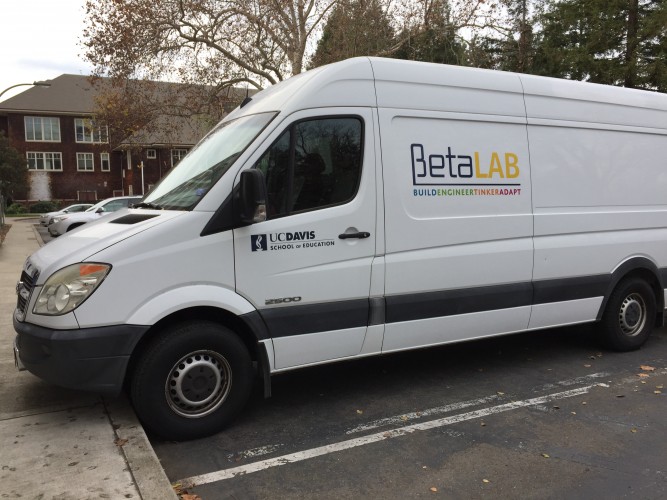
The Beta Lab at UC Davis studies how young people learn and develop through participation in making and the Maker Movement. We investigate the nature of learning that occurs during extended, youth-driven maker projects, and we design learning environments and tools to support learning through making.
“Making” as a Pathway to Engineering
November 2013
The “Maker Movement” brings together engineers, hobbyists, artists, and tinkerers to design, build, and repurpose materials that are “playful, creative, yet also technically sophisticated and ambitious,” according to Assistant Professor Lee Martin.
This kind of “tinkering” or making, especially among young people, can lead to careers in engineering. Unfortunately, according to Martin, playful, creative and ambitious project-based learning is often missing in K-12 settings, leaving many youth with no pathway to this critical field of study.
Bridging Mathematics Learning In and Out of School through Mobile Devices
Study presented by Tobin White and Lee Martin at AERA Meeting on April 28, 2013
Most educators recognize the ubiquity of mobile devices in the lives of their students and too often see them only as competition to learning in the classroom. Two researchers at the UC Davis School of Education are exploring another possibility: that mobile devices have the potential to bridge formal and informal learning, particularly in mathematics, and can be leveraged to increase student engagement in learning math.
Adaptive Expertise: Studying STEM Learning in an Out-of-School Program
Februrary 2013
Everyone agrees that schools need to do a much better job of preparing students for learning and work in science, technology, engineering and mathematics (STEM) disciplines. Unfortunately, discussions of STEM learning are too often driven by scores on large-scale standardized tests, argues Lee Martin, assistant professor in the School of Education.
Integrating Digital and STEM Practices
Article by Tobin White and Lee Martin in Leadership - December 2012
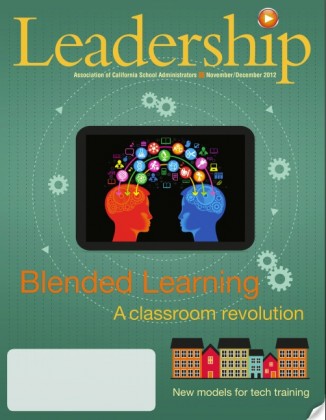
Professors Tobin White and Lee Martin have penned an article on how schools can leverage the ways students are already using mobile digital devices to organize and support learning activities in STEM content areas in the November/December 2012 issue of Leadership, a magazine published by the Association of California School Administrators.
Their article, which “calls attention to opportunities, often missed, to capitalize on emerging media for innovative and even transformative educational use,” appears on pp. 22-26. Access the magazine online here.