

Overview
Chronic absenteeism in kindergarten continues to be a pressing challenge across California. Chronic absenteeism rates (missing 10% or more of the school year for any reason) in kindergarten increased dramatically from 15.6% in 2020-21 to over 40% in 2021-22.
Missing too much school during a child’s formative years is particularly worrisome given the longer term consequences it can have on their educational development.
Despite these alarming increases, we identified 20 districts with significantly lower chronic absenteeism rates.
Our Bright Spots research aimed to discover why rates were lower in three such districts: Livingston Union, Cypress School District and Kings Canyon Unified. Through in-depth site visits, we documented approaches and conditions that collectively help inform ways to get more kindergarteners back into the classroom and ready to learn.
Kindergarten Chronic Absenteeism Rates in Bright Spots Districts Compared to the State
| |
State |
Livingston |
Cypress |
Kings Canyon |
| 2019 |
15.6% |
6% |
5.9% |
9.6% |
| 2023 |
36.3% |
28.1% |
22.8% |
26.7% |
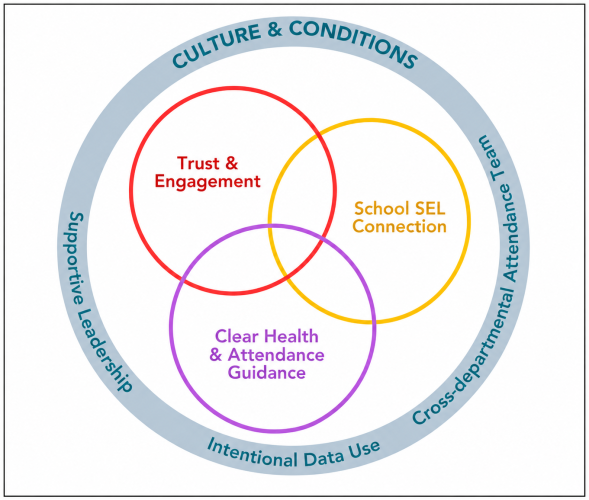
Across all three districts, we found a set of common conditions that supported successful approaches to reducing absenteeism:
 Approaches
An intentional focus on building trust and engagement between schools and families: Creating a culture of trust and engagement is a mutual endeavor that everyone at the school supports.
Establishing a school climate where children connect emotionally to their schools and peers: Schools help kindergarteners develop kindness and empathy which motivates their peers to show up to school.
Clear guidance on supporting children’s health and wellbeing: Parents and school staff understand ways to reduce health-related absences, including when to keep students home versus sending them to school.
Culture & Conditions
A cross-departmental attendance team led by a principal who is an accountable leader who takes full responsibility for results and actions, irrespective of the outcome: Each district and school employs an attendance team model that has “synergy” and open lines of communication about which students and families are in need of support to overcome barriers to attendance. School leaders set the tone, advocating for and enacting conditions for success.
Intentional and strategic use of data in real time to drive decision making: Attendance data is shared openly and used in real-time to proactively diagnose and target outreach to students and families needing additional support.
Approaches
An intentional focus on building trust and engagement between schools and families
Building trusting relationships and fostering engagement was deeply embedded in the school culture and mindsets of administrators, staff, and teachers. School staff, principals, and parents often described their schools as an extended “family”. Creating trust and engagement with families was a school-wide effort, a responsibility that everyone felt was their duty and obligation. Because of this shared responsibility, school staff could turn to each other for advice, ideas and support especially when addressing attendance challenges.
When strong relationships and trust exist between schools, and families, children want to show up every day. Furthermore, these trusting relationships help families feel comfortable sharing their barriers to attendance and trusting schools to partner with them to resolve challenges.
“I got home and I told my husband I was like ‘Oh my God, [the principal] knew her name.’ I was like, ‘It feels nice. It’s not just a show.’ They really are invested and they really care and love what they’re doing and it shows.” - Parent
Recommendations:
- Develop personalized relationships with each family and child. Get to know who children are beyond just their academics, and check in with families before there are any issues or concerns.
- Support students and families struggling with attendance by using positive messaging and reinforcements, such as greeting returning students with, “Welcome back! We missed you!” instead of questioning them about their absence or using punitive approaches.
- Find innovative ways to leverage newsletters, technology and apps (e.g., ParentSquare or ClassDojo) to build and sustain open dialogue and two-way communication with parents.
- Don’t underestimate the influence of a caring, friendly and personalized welcome and send off! Drop-off and pick-up times are great opportunities for connecting with families.
- Invest in creating engaging and effective classroom learning environments. Regularly update families on what students are doing in the classroom to emphasize that missing school means missing invaluable learning opportunities, highlighting their role in building a crucial foundation for future learning.
A school culture and climate where children connected emotionally to their schools and peers
Several schools helped kindergarteners connect emotionally with their schools and peers. Part of that connection involved establishing a climate of safety and warmth that drew students in. This also included developing students’ kindness and empathy for each other.
Recommendations:
- Leverage existing socio-emotional lessons and interventions that are interwoven with the curriculum to strengthen students’ bonds and connection to school so that students feel cared for, included, connected and drawn in.
- Create experiences and engagement opportunities that make students feel important and know that someone is looking forward to seeing them at school.
Example in Practice
 A unique example of how one kindergarten teacher in our study developed children’s empathy for their classmates who miss school was captured by National Public Radio (NPR).
As part of her morning routine, Ms. Dickey at Selma Herndon Elementary posts individual student photos on a white board and places any student who is absent that day into the center of a heart drawn on the board. This reminds all students that when they are absent, they will be missed, and friends will be waiting for them when they return.
Scan the QR code to listen to the segment!
Clear guidance on supporting children’s health and wellbeing
Parents had clear information about keeping their kindergarteners healthy in order to reduce health related absences. When students were sick, there was a straightforward and easy way for parents to get advice and guidance about whether to send their child to school. Schools also supported students’ socioemotional wellbeing.
Example in Practice
 Jefferson Elementary psychologist, Ms. Romero, uses “social stories” to provide students struggling with attendance with a clear and comforting roadmap to their school day, helping them feel prepared and less anxious.
Scan the QR code for a K-2 social story!
Recommendations:
- Ensure that health aides and school nurses are fully incorporated into attendance teams. They can offer advice to parents about whether to send their children to school if they are sick. Listen to the NPR episode on Nurse Lori’s amazing work!
- Include school psychologists and mental health staff on attendance teams to support children with behavioral health issues, especially those with anxiety. For example, use “social stories” to help children envision their school day, read by staff or parents.
- Take advantage of using the front office as a transition space for reluctant kindergarteners to spend time with school staff, allowing them to navigate their feelings and transition back into the classroom.
- Explicitly address students’ health needs. Teachers should acknowledge conditions like allergies, asthma, or other chronic health issues in communications with families. This reassures families that staff are prepared to address health issues, encouraging regular attendance.
Conditions
A cross-departmental attendance team led by a principal who is an accountable leader
Each school had an attendance team made up of representatives from throughout the school community, including teachers, paraeducators, front office staff, administrators, counselors, nurses, bilingual parent liaisons, and parents.
The teams were dynamic, flexible and responsive. They constantly communicated throughout the day. Each team member knew what piece of the attendance puzzle they were responsible for. Principals who led these teams took responsibility for their actions and were fully accountable to students and families.
“…nothing slips through the cracks because everyone’s talking to each other. They’re either talking to the parents or they’re calling me and they’re saying, ‘Hey, you need to check up on the student. They’re not here for whateverreason.’ It’s the teachers holding me accountable as well, because [attendance is] a school goal, so therefore it’s me leading that charge.” – Principal, Cypress
Parents recognized this team approach to attendance with one parent noting how the team–from the principal to the cafeteria workers–worked seamlessly like a “well-oiled machine”.
“It’s a team effort here. From the principal to the janitor, everyone knows the kids and their families. We work together, share information, and support each other to ensure every child feels valued and attended to.” - Teacher, Cypress
Recommendations:
- Ensure that there is a formal attendance team that has open lines of communication, engages regularly with families, as well as establishes and enacts a “culture of support”.
- Having an attendance team led by the principal sends a message about the priority of this team throughout the school community, and also keeps the principal informed about the school’s day-to-day attendance.
Intentional and strategic use of data in real-time to drive decision making
Examining their attendance data in real time allows schools to immediately identify students who need individualized intervention and support. Regularly sharing attendance data across the district and collectively reviewing it allows principals to troubleshoot challenges together and share strategies or identified barriers to school attendance.
“When I bring up the students’ information, I’m looking at grades, I’m looking at their attendance. So if I pull up that quick lookup on PowerSchool and I see that there’s a lot of absences, that becomes a conversation with parents.” - School-site Learning Director, Kings Canyon
Recommendations:
- Data does not have to be complicated! Compiling a list of students who are absent every day and tracking patterns over time is enough.
- Following up with a family the morning they are absent is the most effective strategy for getting that student to school.
- All of the schools we visited worked directly with parents to help them understand attendance policies and procedures and shared the data they collected around absenteeism and tardies.
Takeaways and Overall Recommendations
Effective attendance strategies observed across Livingston Union School district, Cypress School District, and Kings Canyon Unified School District highlight the importance of understanding local contexts and addressing community-specific needs.
Each district uniquely integrates community-specific practices that make students feel valued and connected.
Overall Recommendations:
- Develop Inclusive Attendance Teams: Build teams that reflect community diversity and maintain close connections with families to understand and address barriers.
- Embed SEL and Health Programs: Tailor these programs to meet local needs, ensuring they make students and families feel an essential part of the school community. Partner with local health organizations to offer on-site services that are most needed (e.g., counseling, immunizations, etc.)
- Combine Data with Empathy: Use data strategically while fostering a nurturing school culture to enhance both attendance and overall student welfare.
 Read more about Livingston Union School District’s successful attendance improvement efforts highlighted by our Bright Spots initiative in the full NPR article!
For any questions or additional information, please email: nhang@ccee-ca.org.
The content that appears on this webpage is the same as the printed research brief. Originally published on the California Collaborative for Educational Excellence website.

