 Executive Summary
Changing school districts, especially for students in the early elementary grades, can disrupt a child’s learning and development while also negatively affecting district enrollment and finances. Although students move districts for many reasons, chronic absence could be an important — yet overlooked — early warning signal. This brief presents new evidence about whether chronic absence (missing 10% or more of school for any reason) serves as an early warning sign that students in kindergarten (K) through 3rd grade are more likely to change districts and if they remain chronically absent in their new districts.
Key Findings
Finding 1
Chronically absent K-3 students are more likely to change districts between school years, about twice that of their nonchronically absent peers. Severely chronically absent students (missing more than 20% of the school year) face the highest chance.
Finding 2
Black K-3 students and students experiencing homelessness who are chronically absent have the highest chance of changing districts. Further, homelessness is a unique risk factor linked to changing districts, independent of students’ race and ethnicity.
Finding 3
Among chronically absent K-3 students, those changing districts were more likely to remain chronically absent in their new districts compared to those who stayed in their districts. This suggests that changing districts adds an additional layer of risk for chronic absence above and beyond the normal risk.
Implications for Action
Since chronic absence may influence district enrollment and finances, these results underscore the importance of addressing absences in order to retain students as well as to improve student outcomes. Given these findings, we recommend several actions:
- Ensure that when a student changes districts, the receiving district gets information about the student’s prior attendance as well as academics. This is especially important for groups experiencing higher rates of chronic absence, such as students experiencing homelessness. This includes providing staff working on attendance and homeless liaisons with information about students’ homeless and chronic absence status after they change districts.
- Create opportunities for staff with attendance- and homelessness-related responsibilities to work together to review data. These staff can also develop shared strategies for reducing absences and preventing unnecessary district mobility. This approach recognizes that both chronic absence and homeless status are risk factors for mobility.
- Prepare for new students with a prior history of chronic absence. Provide them and their families with a warm welcome, such as through meet-and-greet events that build trust and engagement.
- Develop early attendance intervention strategies and supports before a student misses 10% of school days, including an assessment of potential barriers to attendance and motivations for showing up. Schools and districts should use this assessment process to pinpoint reasons why families of chronically absent students change districts. Doing so can lead to interventions that better retain and support families.
Chronic Absence and District Mobility
Chronic absence across California is an ongoing concern. While the statewide chronic absence rate decreased from 30% to 19.4% between the 2021-22 and 2024-25 school years, the current rate (19.4%) remains well above rates in 2018-19 (12.1%).1 High rates of chronic absence are troubling given the negative consequences of absenteeism on students’ academic achievement,2 probability of high school dropout3 and socioemotional outcomes.4
Despite the link of chronic absence to poorer outcomes, how it relates to district mobility is less well understood. If chronically absent students are more likely to change districts, these changes could be counterproductive in reducing chronic absence since higher student mobility can exacerbate absenteeism.5 Mobility can further constrain students’ social connection with peers, affecting their psychological well-being.6 Yet enrolling in a new district may stabilize or reduce absences for some children because of the additional supports and services that the new district could offer. Finally, many factors drive absences,7 and some are structural in nature, such as access to transportation8 and housing instability.9 When students and families in a new district face the same structural challenges, chronic absence may continue to persist.
Understanding whether chronically absent students are more likely to change districts can help districts strategize ways to retain and support their chronically absent students. If chronic absence persists or increases after students change districts, receiving districts and schools may benefit from ensuring that they have information about students’ prior absenteeism so that they can diagnose any attendance challenges and offer supports sooner rather than later. Finally, chronic absence itself can serve as an early warning sign that students are at risk due, for example, to a challenge like homelessness that can be difficult to detect.10
Report Aims
This report answers two key questions:
- What is the probability that chronically absent students change districts?
- For chronically absent students who change districts, what is the chance they remain chronically absent in their new districts?
Data and Method
We analyzed anonymized longitudinal student-level data provided by the California Department of Education for students initially enrolled in kindergarten through 3rd grade for the 2022-23 school year and, subsequently, in 1st through 4th grade in 2023-24. In total, the sample includes nearly 1.6 million students who attended traditional public schools. Table A1 in the Appendix provides descriptive statistics on the sample. Details of the sample and methods are also in the Appendix.
Findings
Question 1: What is the probability that chronically absent students change districts?
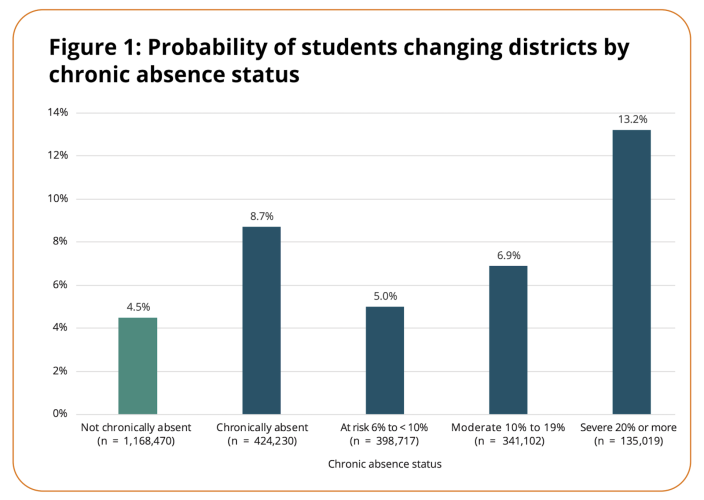 Finding 1: Chronically absent K-3 students are more likely to change districts between school years, about twice that of their nonchronically absent peers. Severely chronically absent students (missing greater than 20% of the school year) face the highest chance.
Figure 1 shows the estimated probabilities of K-3 students changing districts during the subsequent school year based on whether they were chronically absent (missing 10% or more of school). Also shown are probabilities of K-3 students changing districts based on chronic absence levels: at risk (missing 6% to less than 10% of school), moderate (missing 10-19% of school) and severe (missing 20% or more of school). Note: These percentages differ slightly from how Attendance Works describes levels of chronic absence: at risk (missing 5-9% of school), moderate (missing 10-19% of school) and severe (missing 20% or more of school). Chronically absent students faced about a 9% probability of changing districts during the subsequent academic year, nearly two times that of students who were not chronically absent. The probability of changing districts between academic years was highest for severely chronically absent students (13.2%), about 2.5 times their nonchronically absent peers.
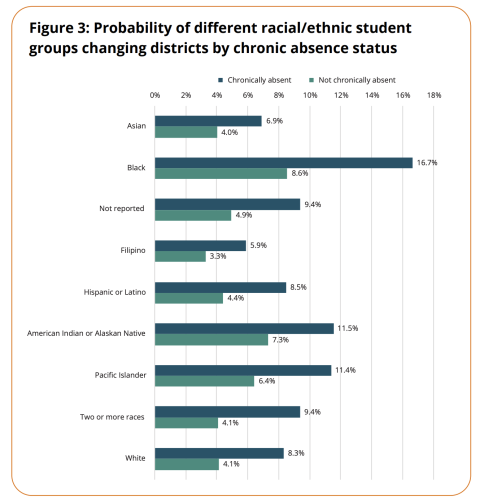
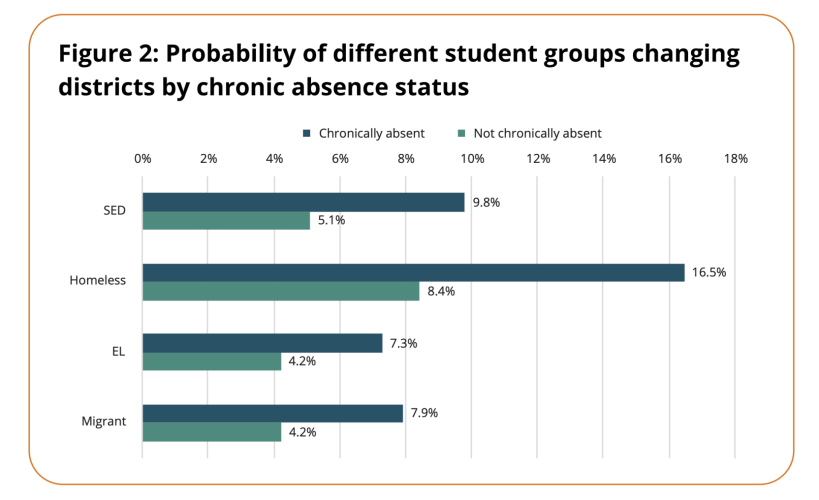 Finding 2: Black K-3 students and students experiencing homelessness who are chronically absent have the highest chance of changing districts. Further, homelessness is a unique risk factor linked to changing districts, independent of students’ race and ethnicity.
Figures 2 and Figure 3 show results by student group. Chronically absent students experiencing homelessness and Black students have the highest probabilities of changing districts. Their probabilities are about 16.5% each, nearly twice that of their nonchronically absent counterparts. Notably, among chronically absent students, homelessness is a unique risk factor for changing districts, independent of race and ethnicity. Regarding the size of these groups to which these probabilities apply, there were 26,935 K-3 students classified as homeless and 29,523 Black K-3 students who were chronically absent during the 2022-23 school year.
 A Note on Chronic Absence, District Mobility and Intersections Between Homeless Status and Race
Given racial disparities in the risk of homelessness, we looked at whether changing districts for chronically absent students depended on their combined racial backgrounds and homeless status (e.g., Black students experiencing homelessness). We found that among chronically absent students, Black K-3 students experiencing homelessness (roughly 2,500 students) had a 27% chance of changing districts during the subsequent school year, the highest of all racial groups experiencing homelessness. Notably, this rate is about 1.5 times higher than either group alone (i.e., chronically absent Black students or chronically absent students experiencing homelessness). Black students experiencing homelessness also face the highest probability of remaining chronically absent after changing districts. This suggests that racial background in conjunction with homeless status can have compounding effects that increase the risk of mobility and these students may require more intensive resources to support their attendance.
 Question 2: For chronically absent students who change districts, what is the chance they remain chronically absent in their new districts?
Finding 3: Among chronically absent K-3 students, those who changed districts were more likely to remain chronically absent in their new districts compared to those who stayed in their districts. This suggests that changing districts adds an additional layer of risk for chronic absence above and beyond the normal risk.
 As shown in Figure 4, after changing districts, chronically absent students faced a 48% chance of remaining chronically absent in their new districts. This is about 3.5 times higher than nonchronically absent students who also changed districts. Further, this is about 4 percentage points higher than chronically absent students who did not change districts. This suggests that changing districts acts as an additional barrier, increasing the risk of chronic absence above the typical risk of their peers who did not change districts.
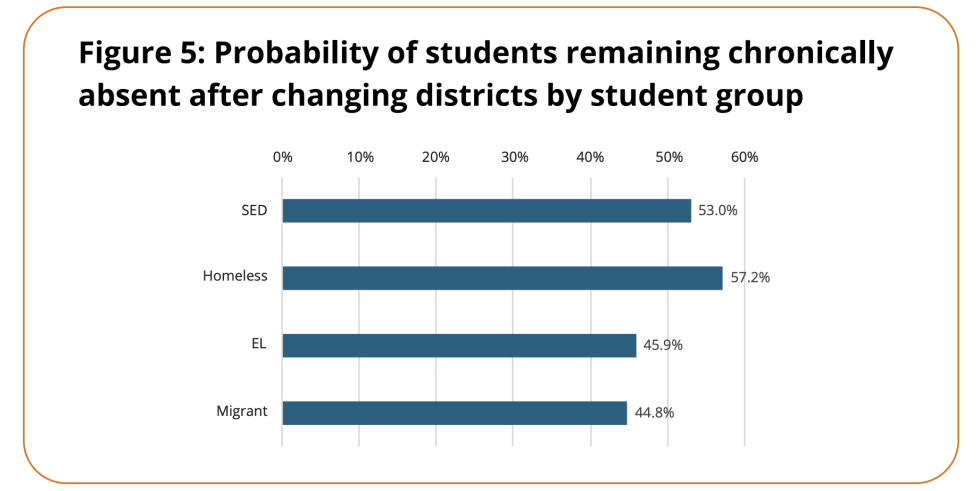
 Finally, comparing student subgroups (Figures 5 and 6) finds that students who are Black or Pacific Islander and students who are experiencing homelessness all face higher probabilities of remaining chronically absent in their new districts. Regarding the size of the groups to which these probabilities apply, there were approximately 8,600 Black K-3 students, 500 Pacific Islander K-3 students and 7,500 K-3 students experiencing homelessness who were chronically absent during the 2022-23 school year and changed districts.
Implications for District Action
Because chronic absence may influence district enrollment and finances, these results underscore the importance of addressing absences in order to retain students and improve outcomes. This section offers recommendations for action.
1. Ensure that when a student changes districts, the receiving district gets information about the student’s prior attendance as well as academics.
Districts can exercise the option to include information about students’ prior history of absenteeism along with academic records when they send information, and receiving districts can also request such information to be shared. Unfortunately, attendance and chronic absence status information is not part of the mandatory permanent pupil records required by California law11 to be transferred within 10 days of a student enrolling in a new district. Attendance is, however, part of the optional information that can be forwarded.
Sharing attendance records is important, especially for student groups that experience higher risks of both chronic absence and changing districts. In fact, chronic absence data itself can be used as an early warning sign to identify students who are at risk because of a challenge like homelessness that can be difficult to detect.12 As part of this process, it is important to make sure such information is received by staff working on attendance as well as by homeless liaisons.
2. Create opportunities for staff with attendance- and homelessness-related responsibilities to work together to review data. These staff can also develop shared strategies for reducing absences and preventing unnecessary district mobility.
For students experiencing homelessness, supports to address both their attendance and their mobility are legally required under the federal McKinney-Vento Act.13 Two key requirements include (a) the designation of district-wide homeless liaisons who ensure identification of students experiencing homelessness and connect them with critical services to support their attendance and well-being; and (b) school stability provisions allowing students to remain in their current schools if it is determined to be in their best interests and to receive transportation (even if crossing district boundaries). Ensuring that homeless liaisons are made aware of a student’s homeless and chronic absence status after changing districts is crucial for addressing any attendance challenges early on.
Given that both chronic absence and homeless status are risk factors for mobility, there are opportunities for attendance teams to work in tandem with homeless liaisons to improve how McKinney-Vento is implemented and identify students early to prevent unnecessary district mobility. Ensuring that parents experiencing homelessness are aware of their right to keep their children in the same school and receive transportation also may prevent transfers. See these resources on improving attendance among students experiencing homelessness developed by SchoolHouse Connection and Attendance Works.
3. Prepare for new students with a prior history of chronic absence.
Districts should consider targeting early attendance intervention strategies and supports, offered before the student misses 10% of days, to chronically absent students who are new to the district. Interventions, such as assigning mentors to students, can strengthen student-to-school connections, increasing the likelihood of more consistent attendance. Another strategy for building trust and engagement is to partner parents in receiving districts with families who are new to the district. Finally, districts should implement best practices to improve attendance for students experiencing homelessness.
4. Develop early attendance intervention strategies and supports, including an assessment of potential barriers to attendance and motivations for showing up.
It is important to understand the drivers behind why families of chronically absent students change districts and why they remain. Changes could be because of decisions that parents or caregivers make or push-out factors in the broader community related to chronic absence, such as unstable housing and lack of access to transportation. On the other hand, families with stronger connections to a school community may be more likely to remain in the district. Pinpointing these reasons can help districts develop better interventions for retaining and supporting families.
Appendix
Table A1. Table of Descriptive Statistics
| Measure |
Percentage |
| Chronic absence for grades K-3 in 2022-23 |
26.6 |
| Chronic absence for grades 1-4 in 2023-24 |
17.1 |
| Log-scaled expenditures (mean) |
9.92 |
| Log-scaled enrollment (mean) |
6.36 |
| Chronic absence severity level in 2022-23 |
| At risk (5-9%) |
25.0 |
| Moderate (10-19%) |
23.6 |
| Severe (>20%) |
8.5 |
| Grade level |
| Kindergarten |
23.5 |
| 1st grade |
25.2 |
| 2nd grade |
25.4 |
| 3rd grade |
25.9 |
| Locale |
| City |
37.5 |
| N/A |
8.8 |
| Rural |
6.4 |
| Suburb |
41.3 |
| Town |
6.0 |
| Gender |
| Female |
48.8 |
| Male |
51.2 |
| Other |
0.02 |
| Race/ethnicity |
Percentage |
Number chronically absent in 2022-23 |
| Asian |
10.0 |
20,527 |
| Black |
4.7 |
29,523 |
| Not reported |
1.3 |
5,480 |
| Filipino |
2.0 |
5,885 |
| Hispanic or Latino |
55.9 |
278,984 |
| American Indian or Alaskan Native |
0.4 |
2,536 |
| Pacific Islander |
0.4 |
2,670 |
| Two or more races |
5.1 |
17,900 |
| White |
20.1 |
60,725 |
| SED |
65.3 |
338,131 |
| Homeless |
4.3 |
26,935 |
| EL |
24.7 |
109,781 |
| Migrant |
0.9 |
3,267 |
| Moved |
6.1 |
N/A |
| N |
1,592,700 |
|
Sample, Measures and Methods
Sample Inclusion Criteria
The sample includes only students in traditional public schools. This was determined by merging the student-level data with Public Schools and Districts Data Files from the California Department of Education and retaining students whose schools were coded as Traditional (TRAD) under the EdOpsCode field.
Measures
Key measures in the analysis included whether or not a student was chronically absent (missing 10% or more of school days for any reason); whether the student changed districts between school years (based on a change in their district identifier between subsequent academic years*); grade level; and the student’s demographic background characteristics, including their race/ethnicity, gender, and whether they were classified as socioeconomically disadvantaged (SED) or an English learner (EL). We also accounted for several school- and district-level characteristics, including school size, district expenditures per average daily attendance (ADA) and geographic locale (city, suburb, rural or town).
*Because charter schools could change identification codes between years due to a change in authorization, we reconducted our analysis with charter schools removed from the sample (results available from authors). Those results are similar to the results presented in this report.
Methods
To answer Question 1, we used logistic regression analysis. We regressed our outcome, a binary indicator for whether a student changed districts between consecutive school years (1 = changed districts; 0 = remained in the same district), on chronic absence in the year prior to changing districts, controlling for observed individual-, school- and district-level characteristics. To answer Question 2, we isolated our sample to students who changed districts and then, using logistic regression, estimated the odds that a student was chronically absent in their new district given their prior chronic absence status. Analyses were replicated for each separate student group. Standard errors were clustered by school. Based on our logistic regression models, we converted estimated odds ratios to fitted probabilities while holding all covariates at their mean.
Limitations
It is important to note that these results are only correlational since district changes are a decision based on multiple factors that we cannot observe (e.g., family residential mobility). In other words, these results do not suggest that chronic absence causes students to change districts; rather, chronic absence is linked to district changes.
Endnotes
- Source: “Chronic Absenteeism Rate: State Report Disaggregated by Ethnicity,” California Department of Education DataQuest (2024-25).
- Ansari, Arya and Robert C. Pianta, “School Absenteeism in the First Decade of Education and Outcomes in Adolescence,” Journal of School Psychology, 76 (2019): 48-61; García, Emma and Elaine Weiss, “Student Absenteeism: Who Misses School and How Missing School Matters for Performance,” Economic Policy Institute (September 2018); Gottfried, Michael A., “Chronic Absenteeism and Its Effects on Students’ Academic and Socioemotional Outcomes,” Journal of Education for Students Placed at Risk (JESPAR), 19, no. 2 (2014): 53-75; Romero, Mariajose and Young-Sun Lee, “A National Portrait of Chronic Absenteeism in the Early Grades,” National Center for Children in Poverty at Columbia University (2007); Santibañez, Lucrecia and Cassandra M. Guarino, “The Effects of Absenteeism on Academic and Social-Emotional Outcomes: Lessons for COVID-19,” Educational Researcher, 50, no. 6 (2021): 392- 400.
- Alexander, Karl L., Doris R. Entwisle and Carrie S. Horsey, “From First Grade Forward: Early Foundations of High School Dropout,” Sociology of Education, 70, no. 2 (1997): 87-107; Rumberger, Russell W. and Katherine A. Larson, “Student Mobility and the Increased Risk of High School Dropout,” American Journal of Education, 107, no. 1 (1998): 1-35.
- Ansari and Pianta, “School Absenteeism in the First Decade of Education and Outcomes in Adolescence”; Santibañez and Guarino, “The Effects of Absenteeism on Academic and Social-Emotional Outcomes.”
- Welsh, Richard O., “Opposite Sides of the Same Coin? Exploring the Connections Between School Absenteeism and Student Mobility,” Journal of Education for Students Placed at Risk (JESPAR), 23, nos. 1-2 (2018): 70-92.
- Rumberger, Russell W., “Student Mobility: Causes, Consequences, and Solutions,” National Education Policy Center (June 2015).
- Gee, Kevin A., “What Contributes to the Variation in Chronic Absenteeism Across the Early Elementary Years? Understanding the Role of Children, Classrooms and Schools,” in Absent From School: Understanding and Addressing Student Absenteeism (Harvard Education Press, 2019).
- Erbstein, Nancy, Stacy Schwartz Olagundoye and Cassie Hartzog, “Chronic Absenteeism in Sacramento City Unified School District: Emerging Lessons From Four Learning Collaboratives Sites,” University of California, Davis Center for Regional Change (2015).
- Galvez, Martha and Jessica Luna, “Homelessness and Housing Instability: The Impact on Education Outcomes,” Urban Institute (December 2014).
- Vohland, Tori, “Using Chronic Absence Data to Identify and Support Students Experiencing Homelessness,” SchoolHouse Connection Blog (n.d.).
- Cal. Code Regs. Tit. 5, § 438.
- Vohland, “Using Chronic Absence Data to Identify and Support Students Experiencing Homelessness.”
- “McKinney-Vento Act: Quick Reference,” SchoolHouse Connection (n.d.).
Acknowledgements
The authors would like to thank the California Department of Education (CDE), especially Jonathan Isler and Piper Stanger for their invaluable support with the data as well as their insightful feedback on prior drafts of our findings. We also appreciate the feedback and support from Cindy Kazanis, Kim Mundenk, and Michael Ishimoto at the CDE alongside the members of the Chronic Absence and Attendance Partnership (CAAP). Special thanks to Gisela Ariza and Catherine Cooney from Attendance Works for sharing their expert insights on prior drafts of this report; Barbara Duffield, executive director of SchoolHouse Connection, who provided invaluable input into the findings and recommendations related to students experiencing homelessness; and Peter Yu at University of California, Davis, who helped prepare the data for analysis. We also acknowledge both Families In Schools (FIS) and Parent Institute for Quality Education (PIQE) for their ongoing partnership in tackling chronic absence in kindergarten and the early grades. Finally, we thank the Attendance Works creative team: Catherine Cooney, who led the editing, design, production and distribution, Sarah Osolin, for her careful proofreading, and Rhonda Saunders for the report design.
This report was made possible through generous financial support from the Heising Simons Foundation. All analyses, conclusions and recommendations in the report are those of the authors.
About the Organizations
Attendance Works is a national nonprofit initiative that advances success in school and beyond for all students by inspiring and catalyzing policies and practices that prevent and reduce chronic absence. Its website offers a wide array of free materials, tools, research and success stories to help schools, districts and communities work together to reduce chronic absence.
The School Policy, Action, and Research Center (SPARC) at UC Davis generates research leading to actionable insights that can support the educational wellbeing of vulnerable youth. Our work supports children experiencing adverse life and social circumstances, including Asian American and Pacific Islander youth who have been bullied, children experiencing chronic absenteeism, and child welfare-involved youth who have experienced maltreatment.
Citation: K. Gee and H. N. Chang, ”Chronic Absence and District Mobility in California,” Attendance Works, January 2026.
The content that appears on this webpage is the same as the printed research brief, without the stock images. Copyright © 2026 Attendance Works, All rights reserved.

