
Teaching Tanzanian Educators How to Engage Their Students in Science and English Language Instruction by Exploring Outdoor Spaces
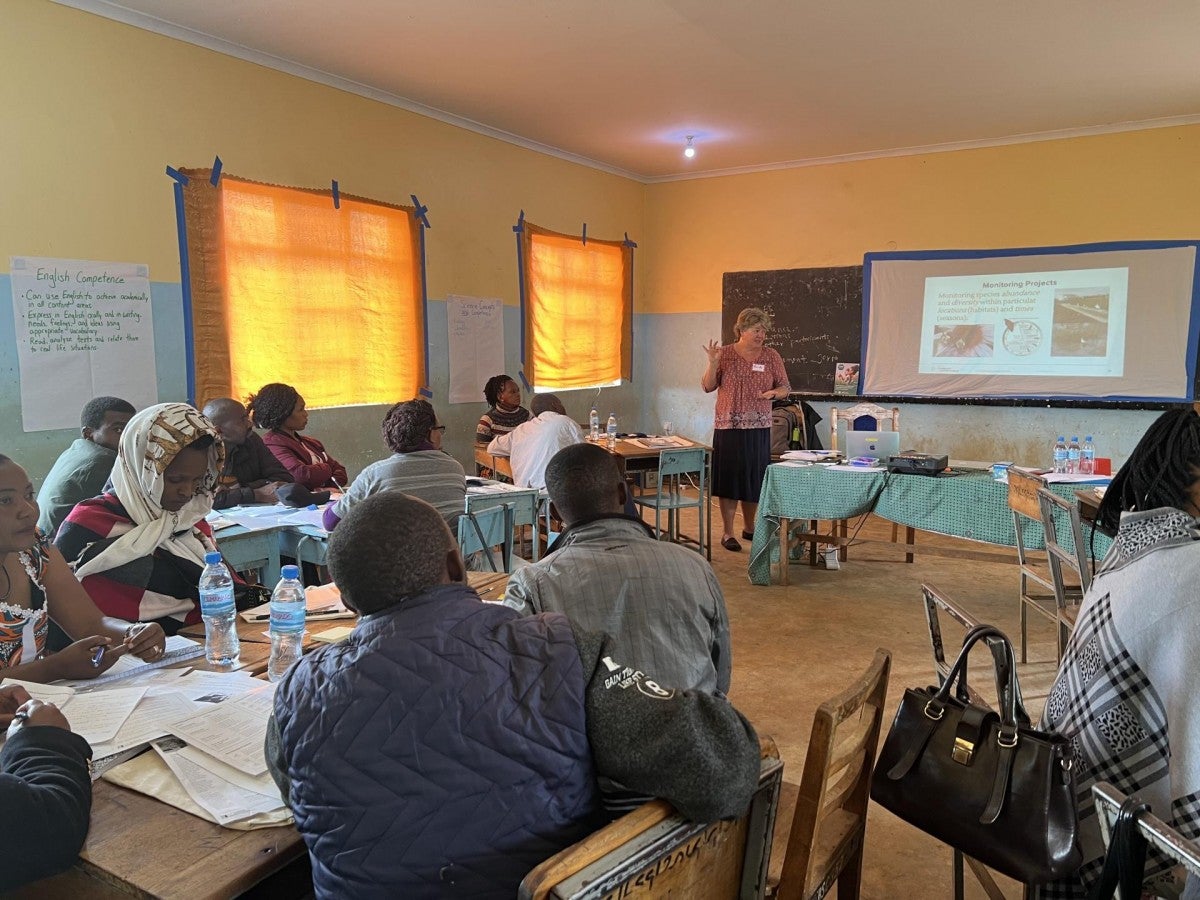
On April 18, 2025, thirty passionate educators from across Tanzania (and beyond) gathered for an interactive workshop designed to transform the way science and English are taught in schools—by taking learning outside.
Led by Youth Education Program Manager Peggy Harte and Dr. Heidi Ballard and from the UC Davis Center for Community and Citizen Science, in partnership with Catherine Njau, Director of Kuleana Youth Empowerment, the workshop focused on one core idea: by engaging with observations of the world around us (specifically school campuses) students deepen both science content knowledge and English language skill building. With the vibrant natural world of the Kilimanjaro region as inspiration, educators explored how outdoor spaces like gardens and schoolyards can become powerful places for students to observe, question, and connect learning across disciplines.
Starting with Wonder
We began the webinar by reflecting on what “science” means to them, reframing it not just as a body of knowledge, but as a practice rooted in curiosity, observation, and inquiry. They considered the question: How can we create opportunities for students to generate their own questions? This thinking set the stage for a shift toward student-centered learning, where young people are positioned as active investigators rather than passive recipients of information.
Language and Science: A Natural Pairing
A key focus of the workshop was integrating English language development with scientific inquiry. Participants discussed how activities like observing birds, documenting plant life, or creating a garden can be deeply language-rich. For example, describing the behavior of a bird in the schoolyard or debating which crops to plant based on soil conditions allows students to practice vocabulary, sentence construction, and critical thinking—skills essential to both science and language learning.
Grounded in Place, Guided by Practice
Using frameworks developed at UC Davis, the educators were introduced to teaching practices that emphasize “sense-making” through local observation and data collection. Activities encouraged students to notice phenomena on their school campuses, ask questions, build models, and revise their thinking based on evidence. Teachers practiced using prompts like “I notice… I wonder… It reminds me of…” to guide student reflection and inquiry.
The group also explored the differences between content-based and competency-based instruction, a pedagogical shift new to many of the teachers in the region. While content might include plant parts or life cycles, competencies focus on skills like analyzing data, advocating for change, and using evidence to inform decisions. By engaging with real-world problems—such as biodiversity on school campuses or the impact of climate change on local agriculture—students can connect their learning to their own lives and communities.
Toward a Global, Community-Centered Vision
This workshop is part of a broader, ongoing partnership between UC Davis and Kuleana Youth Empowerment, initially supported by a Global Affairs Grant from UC Davis. Together, the two organizations aim to build a global network of youth-centered, community-driven science programs that amplify local knowledge and promote environmental stewardship.
From Davis, California to the Kilimanjaro Region of Tanzania, this collaboration emphasizes that meaningful science education starts with community—and that young people, when empowered, can be powerful drivers of change.
As one participant put it, “When students are learning in the garden, they are not just learning science—they are learning how to think.”