
“What would make you proud to present your work?” Spinning Salmon Showcase celebrates student science, storytelling and stewardship
What happens when you invite students who’ve been raising salmon, collecting data, and diving into real-world environmental challenges to share their science with the world?
You get a room full of paper mâché, research posters, dioramas, personal essays, poems, storytelling, and more!
 On May 14, 2025, over 80 students,
teachers, family members, scientists, and community members
filled the auditorium at Maine Prairie High School for the first
annual Spinning Salmon Showcase. More than 40 students from eight
schools across Solano County came together to present what they’d
been working on all year, not just as students, but as
researchers and advocates (Figure 1). The Showcase served as a
celebratory close to the 2024/25 Spinning Salmon Program year.
On May 14, 2025, over 80 students,
teachers, family members, scientists, and community members
filled the auditorium at Maine Prairie High School for the first
annual Spinning Salmon Showcase. More than 40 students from eight
schools across Solano County came together to present what they’d
been working on all year, not just as students, but as
researchers and advocates (Figure 1). The Showcase served as a
celebratory close to the 2024/25 Spinning Salmon Program year.
Giving Students the Mic
This year, a new advocacy element was added to the program, the Spinning Salmon Showcase. The showcase was more than just creating space for students to participate in the program, this was an opportunity to give students the mic.
Although putting together a student showcase has been an idea for the past couple of years, funding was always a challenge. Thanks to the Community and Citizen Science in Conservation Fellowship, UC Davis Ph.D. student Becca VanArnam received funding to organize the showcase locally, in Solano County, as a culminating event where students could reflect on their work and share it in a way that was meaningful to them. Becca looked to help students realize that their voice, their ideas, and their experiences matter in science, and in their communities. And they did not disappoint!
Built WITH Students and Not Just For Them
In the months leading up to the event, the goal was clear: this showcase shouldn’t be something designed for students, it should be something shaped by them. To make that happen, Becca visited classrooms across Solano County, listening to students’ ideas, asking what they were excited to share, and working with teachers to figure out what materials and support were needed to bring those ideas to life.
Whether students wanted to build a diorama, present a poster, or try something totally different, the planning process centered around one question: “What would make you proud to present your work?” That spirit of co-creation ran through every part of the event.
The event came to life thanks to the support and collaboration of many people behind the scenes. Peggy Harte, Youth Education Program Manager with CCCS, played a critical role throughout the planning process. Carson Jeffres from the Center for Watershed Sciences and Rachel Johnson from NOAA offered invaluable guidance along the way, and support with publicizing the event and encouraging members of the scientific community to attend and support the students.
Maine Prairie High School hosted the event at their school, and helped bring the vision of the showcase to life! Staff and students from Maine Prairie not only participated, but also played a key role in making sure the space felt welcoming, celebratory, and student-centered. From setting up the presentation areas to offering technical support, Maine Prairie’s contributions made it possible for everyone to feel seen and supported as they shared their work.
A Whole Community of Contributions
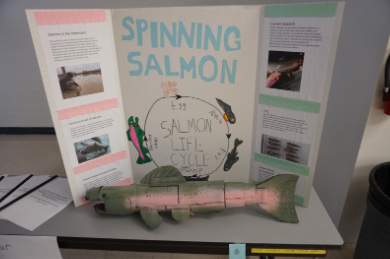 Across the room, guests explored a
mix of presentations. One group, through an eye-catching salmon
model, told the salmon life cycle story capturing their changes
from egg to spawning adult (Figure 2).
Across the room, guests explored a
mix of presentations. One group, through an eye-catching salmon
model, told the salmon life cycle story capturing their changes
from egg to spawning adult (Figure 2).
Others looked to tell their story through a Scientific Research
Poster reflecting on personal experience of witnessing
environmental changes over time, and of realizing they had a role
to play in conservation (Figure 3).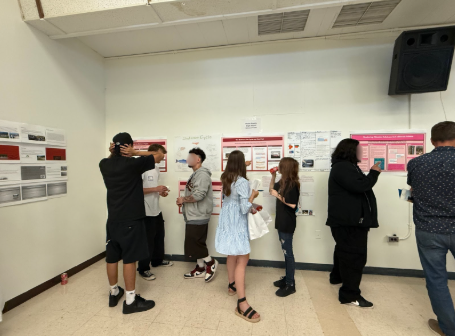
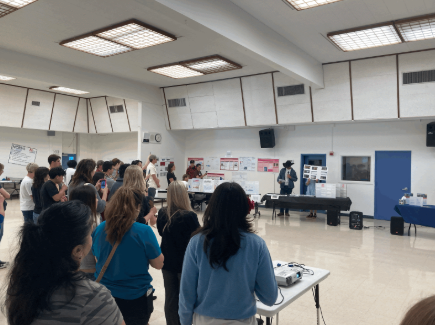 One of the standout moments of the
day came when a student from Maine Prairie High School decided to
share their work and story with the whole crowd (Figure 4). With
a mix of nerves and pride, they talked about how the project
reminded them of fishing trips with family including long days by
the water. This student has been a part of the Spinning Salmon
Program for two years, and is a thoughtful and curious voice,
always asking questions and inspiring others to do the same.
Their passion didn’t go unnoticed: researchers at the UC Davis
Center for Watershed Sciences invited them to tour their lab and
learn more about the kind of work that keeps our rivers and fish
populations healthy.
One of the standout moments of the
day came when a student from Maine Prairie High School decided to
share their work and story with the whole crowd (Figure 4). With
a mix of nerves and pride, they talked about how the project
reminded them of fishing trips with family including long days by
the water. This student has been a part of the Spinning Salmon
Program for two years, and is a thoughtful and curious voice,
always asking questions and inspiring others to do the same.
Their passion didn’t go unnoticed: researchers at the UC Davis
Center for Watershed Sciences invited them to tour their lab and
learn more about the kind of work that keeps our rivers and fish
populations healthy.
Looking Ahead
After the showcase, Dina Flamik, Science teacher at Mainie Prairie shared the following:
“Having the showcase gave the students their purpose. They went into it thinking I’m gonna stand in front of all these people and be proud. And they were. They were really proud of their work.”
The first Spinning Salmon Showcase wasn’t just a year-end event, it was a step toward something more. It was a space intentionally designed to center student voices, to create opportunities for young people to share their ideas, questions and creativity. The showcase marked an important move in the direction of amplifying youth perspectives in community and citizen science. As one student said while packing up:
“I hope we get to do this again next year, only bigger.”
More Information about the Spinning Salmon Program
This program is a collaboration between UC Davis Center for Community and Citizen Science (CCCS), UC Davis Center for Watershed Sciences, the National Oceanic and Atmospheric Administration and the Department of Fish and Wildlife. The program invites students to investigate thiamine deficiency in local salmon populations, a real ecological issue affecting fish behavior and survival. The program was originally launched through a partnership with GEAR UP (Gaining Early Awareness and Readiness for Undergraduate Programs) Rural Valley Partnership, a UC Davis Department of Education grant program focused on preparing students for postsecondary success. With GEAR UP, this program brought this research opportunity to Glenn, Tehama, and Colusa Counties. The program then expanded through a grant from NOAA to the Solano County Office of Education, supported by the California Bay Watershed Education and Training (B-WET) program, the Spinning Salmon Program now includes Solano County students, including those in continuation high schools, a juvenile detention hall, and a Deaf and Hard of Hearing Program. Together, these partnerships have allowed thousands of students across Northern California to participate and shape this program.