
Youth Voices in Action: Advocacy and Outreach in the Spinning Salmon Program
By Peggy Harte, Youth Education Program Manager, UC Davis Center for Community and Citizen Science
When the Spinning Salmon Program launched five years ago, it set out to engage youth in emergent science, spark curiosity and foster a deeper connection between youth and the researchers focused on salmon in California. Through participatory science, the program has done more than build knowledge and engage youth—it has shown young people that they have the skills to take an active role in scientific discovery and environmental stewardship. Over the past year, students have demonstrated how engaging in real-world research cultivates not only 21st Century skills but also a deeper understanding of purpose as they begin to see themselves as authentic members of the research team. As important members of this scientific group, they’ve gone on to share their data, raise critical questions, and contribute meaningfully to conversations about salmon health—reaching audiences from their own communities and beyond.
Lifting Student Voices through Storytelling
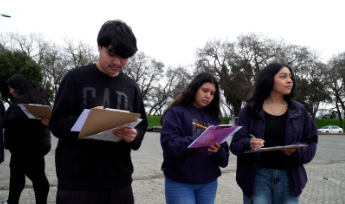 One of the most exciting moments for
our students came this spring, when NOAA published a national web
story featuring the Spinning Salmon Program:
High Schoolers Help Federal Biologists Unravel the Mystery of
Spinning Salmon. This beautifully written piece brought
national attention to our students’ role in investigating
thiamine deficiency in Chinook salmon, a pressing ecological
concern. For the Solano County students featured, seeing their
work lifted up on a national stage validated their contributions
and affirmed their place in the broader scientific community. It
also gave them the opportunity to explain—in their own words—why
salmon matter to their communities, cultures, and futures.
One of the most exciting moments for
our students came this spring, when NOAA published a national web
story featuring the Spinning Salmon Program:
High Schoolers Help Federal Biologists Unravel the Mystery of
Spinning Salmon. This beautifully written piece brought
national attention to our students’ role in investigating
thiamine deficiency in Chinook salmon, a pressing ecological
concern. For the Solano County students featured, seeing their
work lifted up on a national stage validated their contributions
and affirmed their place in the broader scientific community. It
also gave them the opportunity to explain—in their own words—why
salmon matter to their communities, cultures, and futures.
Celebrating and Showcasing Learning
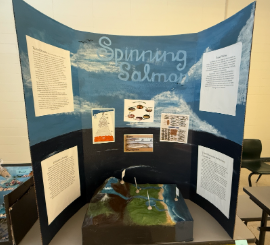
In May, the Center brought students, families, educators, and partners together for our first Spinning Salmon Student Showcase—a celebratory event that honored the hard work and creativity of participating youth. Student teams presented posters, art work and calls to action about their monitoring, tank observations, and data submission. They also shared powerful reflections about what it means to be a “salmon steward” in a time of climate uncertainty and ecological change.
 As one student reflected, “I
learned how important salmon are—not just as a living organism
and food sources for predators, but because, when they die, their
bodies put nutrients back into the soil. It was exciting to be a
part of a project that’s having a real-world impact for salmon so
they can continue serving our ecosystem.”
As one student reflected, “I
learned how important salmon are—not just as a living organism
and food sources for predators, but because, when they die, their
bodies put nutrients back into the soil. It was exciting to be a
part of a project that’s having a real-world impact for salmon so
they can continue serving our ecosystem.”
These kinds of moments remind us that science education is also civic education. The Showcase gave students a platform not just to report on data, but to voice their ideas for change—in their schools, neighborhoods, and ecosystems.
From the Classroom to Scientific Literature
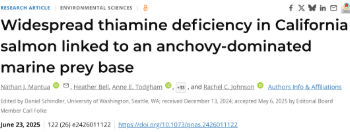 In one of the most remarkable
developments of the year, student-collected data from the
Spinning Salmon Program contributed to a peer-reviewed scientific
paper: “Widespread
thiamine deficiency in California salmon linked to an
anchovy-dominated marine prey base“, published in Proceedings
of the National Academy of Sciences. Students’ observations of
salmon fry behavior and mortality in classroom tanks helped build
a stronger dataset that supported NOAA scientists’ analysis.
In one of the most remarkable
developments of the year, student-collected data from the
Spinning Salmon Program contributed to a peer-reviewed scientific
paper: “Widespread
thiamine deficiency in California salmon linked to an
anchovy-dominated marine prey base“, published in Proceedings
of the National Academy of Sciences. Students’ observations of
salmon fry behavior and mortality in classroom tanks helped build
a stronger dataset that supported NOAA scientists’ analysis.
This is not just a milestone for the program—it’s a statement about what youth are capable of when given the right tools, support, and opportunity. Students’ data and observations were rigorous enough to meet the standards of the research team, which allowed them to be included in this journal, one of the world’s most prestigious scientific journals. That sends a powerful message about the potential of youth-led community and citizen science to inform real-world research and policy.
Looking Ahead
As we continue to grow the Spinning Salmon Program, we are committed to deepening opportunities for youth to share their knowledge, tell their stories, and shape the future of salmon stewardship in California. This means more storytelling opportunities, more partnerships with scientists and decision-makers, and more platforms where youth voices are not only heard, but sought after.
The science is important—but the shift in identity that happens when students see themselves as researchers, as advocates, as stewards—that’s where the real transformation lies.
Many thanks to our partners-
We’re grateful to our partners at NOAA Fisheries, the California Department of Fish and Wildlife and the Center for Watershed Sciences at UC Davis for helping us make this work possible. We are also grateful for our funding/collaboration partners- through the GEAR UP college opportunity program STEM Rural Valley Partnership, students in Glenn, Tehama and Colusa counties were able to participate in the Spinning Salmon program, supported by their teachers and advisors and the Solano County Office of Education.