
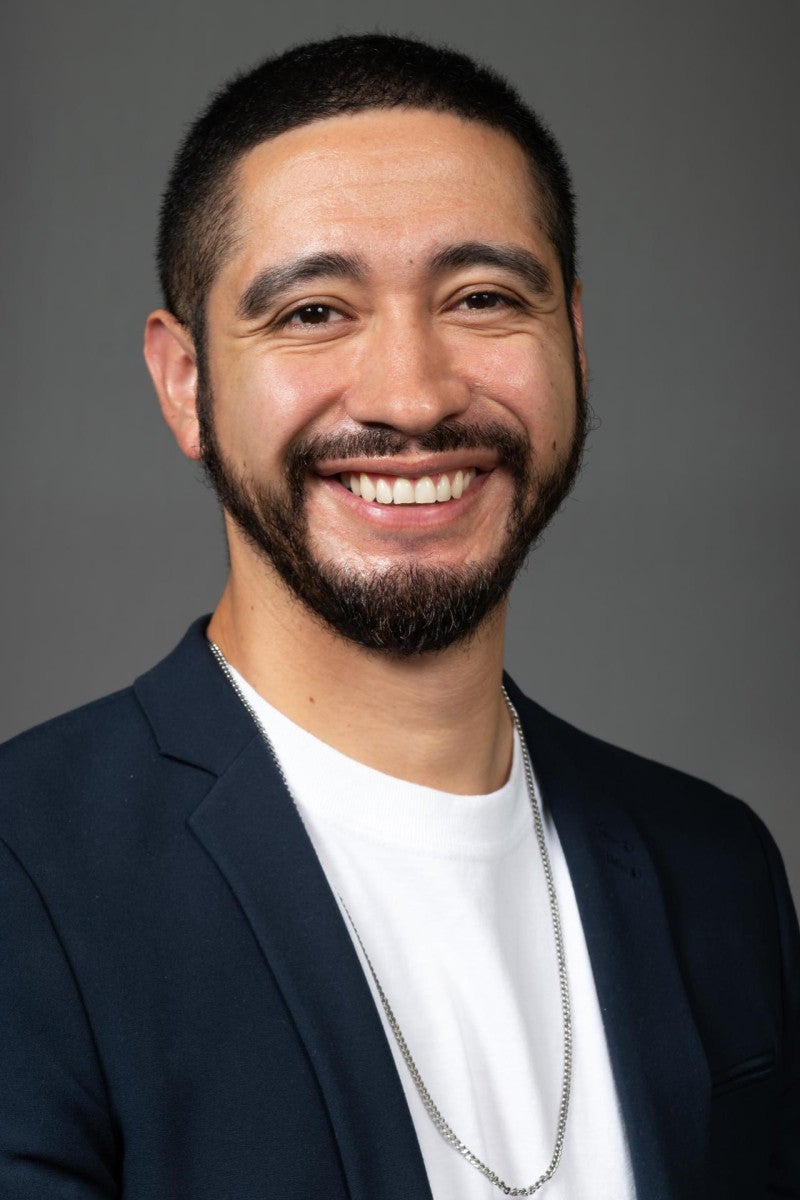
How Ph.D. Candidate Jaime Ramirez-Mendoza Is Rethinking Financial Aid for Students of Color
 For many college students of color,
accessing higher education isn’t a straightforward process.
Financial aid applications can be confusing, time consuming, and
filled with barriers that make college feel out of reach before
students even step onto campus.
For many college students of color,
accessing higher education isn’t a straightforward process.
Financial aid applications can be confusing, time consuming, and
filled with barriers that make college feel out of reach before
students even step onto campus.
That experience is at the center of Ph.D. candidate Jaime Ramirez-Mendoza’s research. A soon-to-be graduate and 2026 commencement speaker, Ramirez-Mendoza studies how financial aid systems create barriers for students while also highlighting the resilience and community support that help many persist through them. “It’s critical that we keep having conversations about financial aid and asking, ‘How are the policies, procedures, and practices racialized?’” Ramirez-Mendoza said. “More importantly, we need to keep sharing stories that highlight the cultural capital students use to persevere in the face of these barriers.”
Students Navigating a System Not Built for Them
Ramirez-Mendoza’s dissertation research drew from interviews he conducted with 76 California high school seniors to better understand how they navigated the financial aid and college application process. Across the interviews, he found that barriers tied to race and inequality — such as language differences, confusing financial aid terminology, and concerns about sharing family financial information or immigration status — shaped students’ experiences applying for aid and, in some cases, whether they pursued college at all.
As he analyzed the interviews, Ramirez-Mendoza realized the challenges students faced were not isolated incidents, but signs of deeper inequities built into higher education systems. “My dissertation was both healing and infuriatingly insightful all at the same time,” he said. “Growing up navigating education and financial aid systems, and later helping students and families navigate those same systems, there was always this feeling that something was off. My research gave language and framing to experiences that so many students and families have been carrying for years.”
Rather than placing responsibility solely on students and families, Ramirez-Mendoza’s research shifts attention toward the systems themselves. “It was always, ‘Parents don’t know this,’ or ‘Students don’t know this,’” he said. “But what if there are systemic reasons for that?”
His research found that students from communities that have historically faced barriers to higher education often encountered longer, more complicated financial aid processes than their peers, even when completing the same applications. At the same time, he witnessed students and families drawing on community networks, multilingual skills, and collective problem-solving strategies to navigate systems not designed with them in mind. “These students weren’t just sitting there taking it,” he said. “They were resisting and persisting, using their brilliance to navigate systems that constantly asked more of them.”
One of the biggest takeaways from Ramirez-Mendoza’s research was that students’ resilience and cultural knowledge should be celebrated, but institutions also have a responsibility to address the inequities that make those survival strategies necessary in the first place. His research argues that students from historically excluded backgrounds are too often forced to survive higher education systems rather than being fully supported by them.
Finding Community and Purpose
Ramirez-Mendoza’s research is deeply informed by his own lived experience as a first-generation, low-income Latino student and by his years advising students and families through programs such as Upward Bound and Destination College Advising Corps. In those roles, he saw firsthand how important access to information, mentorship, and community can be for students aspiring to attend college. “You have to find tactics that reverse decisions the system made for you: to leverage the system to make decisions that actually work for you,” Ramirez-Mendoza said. “As an advisor, I realized it was never a lack of trying on my students’ parts that kept them from college. It was never a lack of brilliance either. It was a gap in access to critical information they needed but had never been given.”
The challenges posed by financial aid also reflect broader barriers students can experience before and during college. For Ramirez-Mendoza, that included feelings of isolation and exclusion as a Latino student from a rural, lower-income community. “I did everything right,” he said. “I was a textbook success: straight A’s, full ride to college. And yet, I still didn’t feel like I belonged.” It wasn’t until Ramirez-Mendoza enrolled in a Chicano Studies elective, which he later decided to double major in, that he found coursework, faculty, and peers that reflected his experiences.
Now, Ramirez-Mendoza hopes his work can help improve the systems that shape students’ pathways to higher education, beginning with financial aid. He credits the School of Education with helping him develop the big-picture approach that now guides both his research and policy work through mentorship, training across multiple fields, and a collaborative community grounded in equity and social change. “When kids are on the last step of that ladder to college,” he said, “I always say, ‘This is going to be hard. But if you create community and honor where you came from, you’ll always find your way.’”
Making Education Systems Fairer
Following graduation, Ramirez-Mendoza will continue his work at EdTrust-West as a senior policy analyst. In this position, he’ll focus on college affordability and programs that allow high school students to earn college credit across California—a role, he explained, that feels like a natural continuation of the approach he developed through his doctoral research. “At EdTrust-West, racial equity and systems change are at the center of the work,” Ramirez-Mendoza said. “My dissertation analyzed how systemic racism manifests within financial aid ecosystems, and now I get to apply that same lens to policy and advocacy work across California.”
Although his work is now more policy-focused, Ramirez-Mendoza still seeks opportunities to work directly with students and families whenever possible. “I’m always energized by students,” he said. “Their brilliance, their creativity, the way they imagine the world differently — it gives me hope. It makes me ask, ‘How can we create systems that help propel students forward instead of placing more checkpoints in front of them?’”
As he prepares to graduate, Ramirez-Mendoza says he is still discovering exactly what shape his long-term career will take. But he knows the core mission will remain the same. “I’ve realized that my passion is making education systems fairer for communities that have historically been left out,” he said. “The privilege now is that there are so many different ways I can do that.”