
School of Education Researchers Receive $1.7 Million Grant to Prepare STEM Teachers for the Age of AI
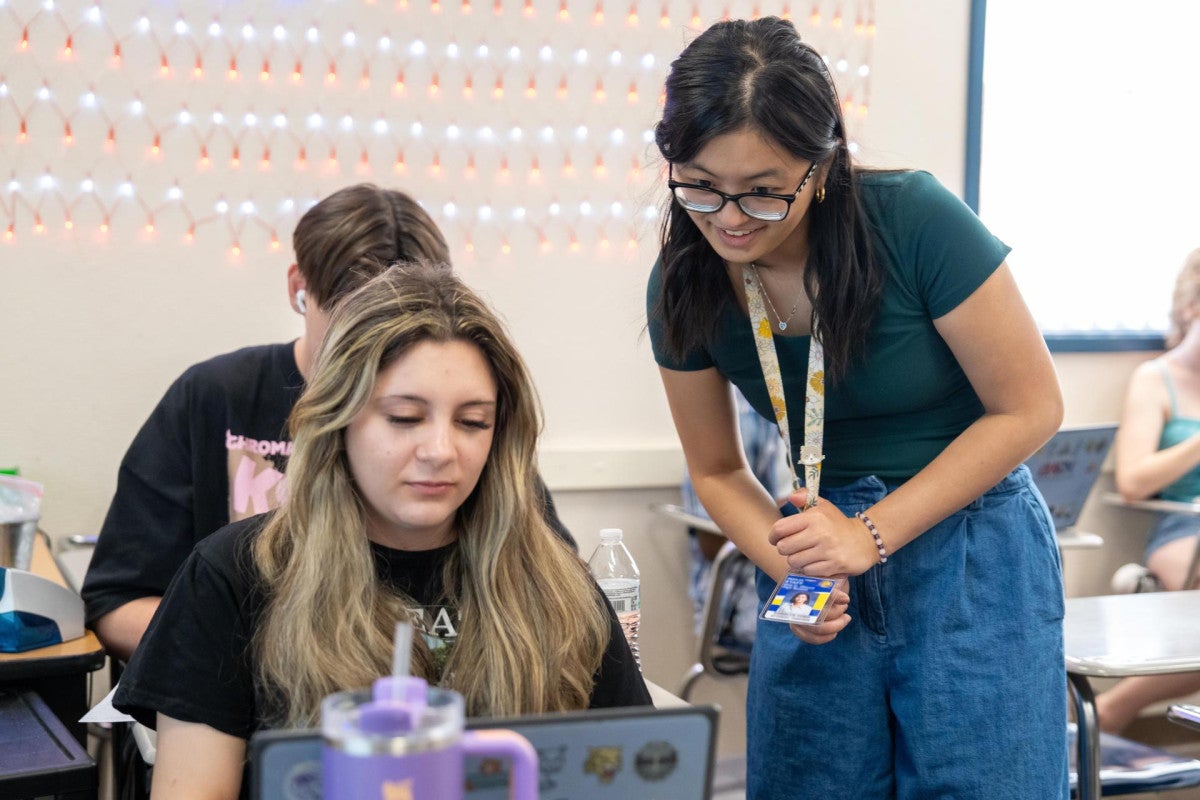
A UC Davis research team has received a $1.7 million National Science Foundation grant to help shape the next generation of educators who can think critically about artificial intelligence and use it to enrich learning. Led by Associate Professor of Teaching in Education Matt Wallace, the five-year project will recruit and mentor early-career math and science teachers, exploring how artificial intelligence can strengthen the human connections that define good teaching.
Twelve selected teacher fellows will each receive a $30,000 scholarship toward the UC Davis School of Education teaching credential and master’s programs, plus a $10,000 annual stipend during their first four years in the classroom. Fellows will gain hands-on experience using AI in high-needs schools, as well as training in AI applications for teaching and learning. They will also have access to teacher workshops, professional learning opportunities, mentoring support, and funding to attend national STEM teacher conferences.
“As we collectively work toward a better understanding of artificial intelligence, it’s critical that teachers are trained to use it responsibly,” said Wallace. “This project is a major opportunity to empower new teachers as they enter the education field, teach in high-needs districts, and work with learners who will deeply benefit from their AI expertise well after our program ends.”
A New Approach to Teacher Retention
The project’s dual mission is to address California’s teacher shortage and give early-service educators the tools needed to navigate a rapidly changing digital landscape. Wallace and the project co-PIs, Profs. Timothy Lewis, Cynthia Passmore, Margarita Jimenez-Silva, and Charles Wilkes, will collaborate with 12 teacher fellows to learn how to effectively leverage AI to advance student learning. These novice teachers will enter the classroom ready to engage their students and colleagues in AI use that enhances the STEM learning experience, rather than undermining it.
By helping student teachers build both AI fluency and classroom confidence, the team hopes to strengthen their long-term commitment to the profession. Educators often decide if they will stay in the teaching field within the first three years of service. Providing pre- and early-service teachers with resources and support will help deepen their commitment to education. “Our goal isn’t just to keep novice teachers in the field. It’s to build a community that supports them for the long haul,” Jimenez-Silva said. “We’re hoping this model will keep our students motivated and excited about being STEM teachers throughout their careers.”
Another key feature of the project is its interdisciplinary design. Experts from diverse fields, including math education and multilingual learning, will collaborate with student teachers to reveal new, unexplored approaches to STEM education and technology. “Our team isn’t coming to this work as if we already have all the answers,” said Jimenez-Silva. “There’s so much to understand, so this is an exciting opportunity to really, genuinely ask: ‘How can we use AI to help kids learn?’”
“With the newness of AI, no one is truly an expert yet,” added Wilkes. “This really provides an opportunity for us to learn from and with each other.”
Why Teach AI Now?
While public conversation around artificial intelligence often centers on fear—of job loss, misinformation, or diminished human connection—the research team sees a different story unfolding in classrooms. “AI is here, and it would be short-sighted to pretend otherwise,” Wallace said. “Our goal is to help teachers and students learn how to use it meaningfully: to improve what we’re already doing instead of taking shortcuts.”
Artificial intelligence also opens possibilities for more inclusive STEM learning that supports students’ engagement with real-world issues. “STEM and AI together can be a powerful combination,” explained Wilkes. “They can help us think more deeply about whose voices are represented in data, what narratives we’re reinforcing, and how we can use these tools in more equitable ways.”
Jimenez-Silva agreed that understanding AI is essential to reducing anxiety about it. “We fear what we don’t understand,” she said. “The more teachers and students engage with artificial intelligence directly, the more we can identify its limits, its potential, and how to use it responsibly. We had similar fears about Google and Wikipedia once and now they’re everyday tools. We want teachers to harness AI’s power while maintaining a healthy skepticism about what it can actually do.”
As the first cohort of STEM teachers begins their journey, the project team hopes to demonstrate that technology and humanity don’t have to be at odds in the classroom. “There’s a human element to teaching that AI can’t replicate,” Wallace said. “But when teachers learn to use it thoughtfully, it can open new doors for how students learn, connect, and imagine what’s possible.”