
Students Prioritize Inclusion at Undergraduate Research Conference
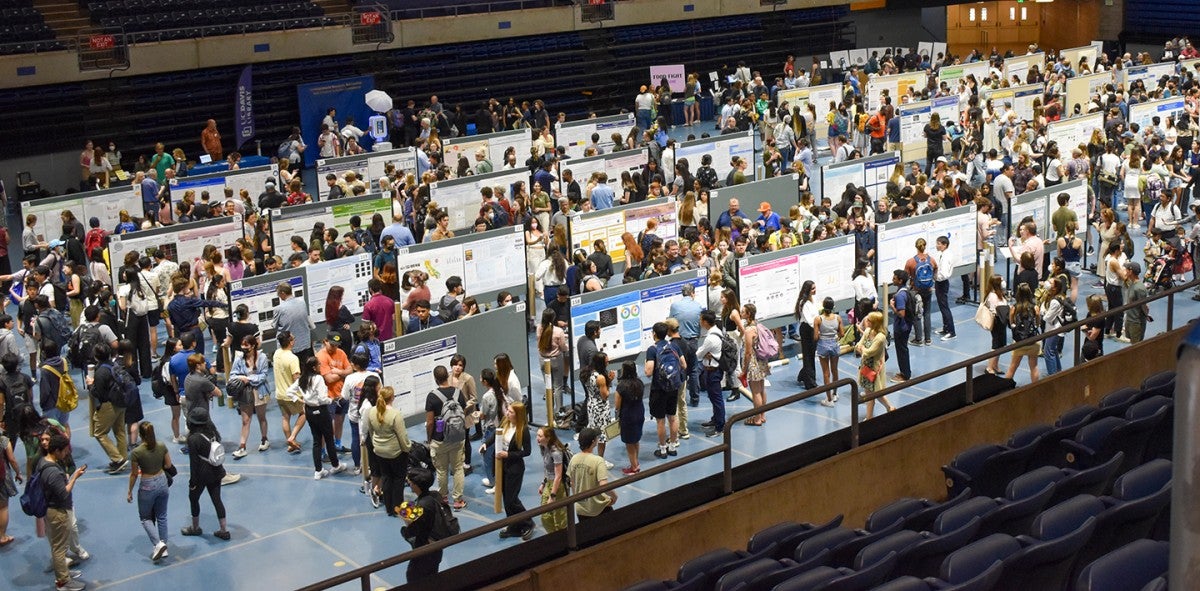 “Conducting my own research made me
realize that science can be a lot of things. It’s
multidimensional and not just for biology or engineering,” said
Kimberly Guatemala-Luna, research assistant to Prof. Margarita
Jimenez-Silva and presenter at the 2025 UC Davis Undergraduate
Research Scholarship and Creative Activities Conference.
Guatemala-Luna, who is double majoring in cognitive science and
psychology and minoring in education, assisted Jimenez-Silva in
executing Comunidad de
Ciencia, a program designed to empower Latinx families to
encourage their elementary-school-age girls’ engagement in
science activities.
“Conducting my own research made me
realize that science can be a lot of things. It’s
multidimensional and not just for biology or engineering,” said
Kimberly Guatemala-Luna, research assistant to Prof. Margarita
Jimenez-Silva and presenter at the 2025 UC Davis Undergraduate
Research Scholarship and Creative Activities Conference.
Guatemala-Luna, who is double majoring in cognitive science and
psychology and minoring in education, assisted Jimenez-Silva in
executing Comunidad de
Ciencia, a program designed to empower Latinx families to
encourage their elementary-school-age girls’ engagement in
science activities.
From the research assistantship, Guatemala-Luna developed her own study that examined the program team’s sense of science identity after leading others through STEM activities. “All of the research assistants saw themselves in the girls we worked with,” she said. “We were so encouraging of the students that we couldn’t help applying that same encouragement to our own work. It was affirming to say ‘If we’re telling them they can do research, why can’t we? We are scientists.’”
One conclusion from Guatemala-Luna’s conference presentation “‘Going that Extra Step’: Authentic Cariño and Servingness at a Hispanic-Serving Institution” was that, if Hispanic-Serving Institutions want to truly serve others, they need to create greater visibility of Latinx students and their accomplishments on campus.
“I experienced a lot of imposter syndrome when I first came to UC Davis,” said Guatemala-Luna. “Finding a group of Latinx students who were conducting their own research—research that leads to positive social change—was impactful. It feels good to say ‘I’m a full-time student and research assistant’ now, because it’s an important reminder that I’m not behind everyone else—I’m not an imposter.”
Finding a Place in Scholarship
Guatemala-Luna was one of 11 School of Education researchers to present at the undergraduate conference—five of whom developed studies from Jimenez-Silva’s original project. Leslie Valdez, a design major with double minors in education and linguistics, uncovered a new passion for research after presenting her findings on the importance of Comunidad de Ciencia as a culturally informed approach to STEM programming.
“I was surprised by how much the project increased our research team’s confidence, especially our self-efficacy as students,” said Valdez. “It allowed me as a non-STEM major to see that I could still be involved in STEM spaces and benefit from them.”
Caroline Van Zant, an undergraduate researcher for Prof. Nicole Sparapani and the CARE Lab, also solidified her researcher identity while conducting her own study. “I was counting the days to be done with school,” she said. “But now I hope to never leave academia.”
Van Zant, a human development major with double minors in education and psychology, presented “Examining Student-Teacher Relationship Quality in School-Aged Students With and Without Autism,” a study that used quantitative data from elementary school classrooms to gauge how teachers interact with students with autism versus those without. She found that autistic students tended to have more conflictual interactions with their teachers, despite their teachers reporting similar feelings of closeness to their autistic and non-autistic students.
“Schools are changing how they serve children with autism,” said Van Zant. “It’s an important time to determine how teachers are forming relationships with autistic students and develop more opportunities for them to strengthen those connections.”
From Research to Action
From a day in the life of a dual-language learner to increasing engagement in STEM learning, the School of Education undergraduate researchers’ conference presentations were grounded in access and inclusion—topics they plan to continue addressing in their own fields of study.
“This research was just one way that I could give back to the student community,” said Hiu Nam Hallie Wong, a communications major and English minor who collaborated with Jimenez-Silva to interview international students and recommend ways that UC Davis can better support their success. “Given all the new challenges international students are facing, I want to explore this topic more.”
The breadth of the students’ projects demonstrates how they’re tackling real-world challenges through original, equity-driven research. Below is a closer look at their work:
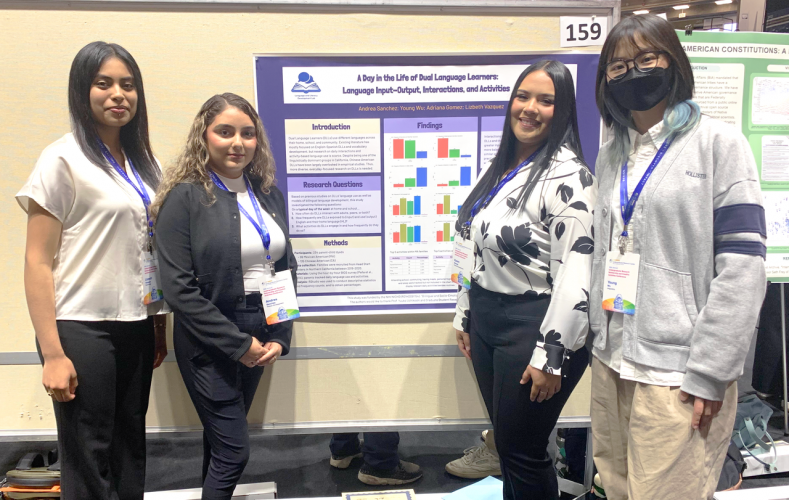 A Day in the Life
of Dual Language Learners: Language Input- Output, Interactions,
and Activities
A Day in the Life
of Dual Language Learners: Language Input- Output, Interactions,
and Activities
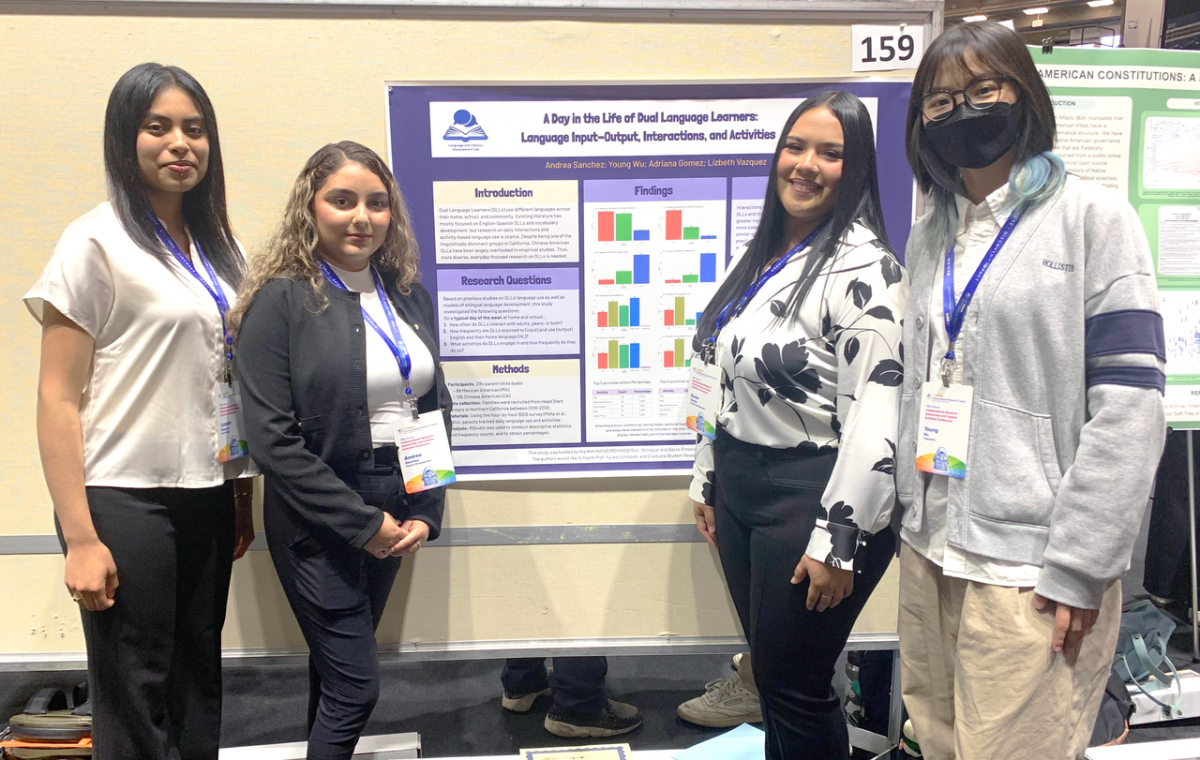
Authors: Andrea Sanchez, Lizbeth G Vazquez, Karen Adriana
Gomez, Young Wu
Sponsor: Yuuko Uchikoshi
Tonkovich
Throughout the day, Dual Language Learners (DLLs) use and hear
different languages at home and school. Research shows these
environments shape DLLs’ bilingual development. While previous
studies have mostly focused on English-Spanish DLLs, research on
English-Chinese DLLs, their interactions with adults and peers,
and the activities they engage in is scarce. This study examines
a typical weekday for DLLs, focusing on their interactions with
adults, peers, or both, as well as the frequency of their English
and home language (HL) use and exposure. It also explores the
activities DLLs engage in. A total of 234 parent-child dyads
(Mexican-American = 99; Chinese-American = 135) participated. At
data collection, DLLs were 3-5 years old. Language interactions,
input-output, and activities were measured using the hour-by-hour
parent-reported Bilingual Input-Output Survey (BIOS). Data was
analyzed with RStudio. Results suggest DLLs interact with adults
more than peers. Mexican-American DLLs receive input mainly in HL
but use both English and HL, while Chinese-American DLLs show
balanced input-output. Both groups engage in play, electronics,
singing, reading, and family time outside their schedules. The
study underscores bilingualism as a daily practice across input,
output, interactions, and activities.
Intentional STEM Programs for Young Latinas can Reduce Barriers to STEM Efficacy and Increase Latina Professionals in These Fields
Author: Maria Galarza-Gonzalez
Sponsor: Margarita Jimenez-Silva
Latina women continue to be underrepresented in STEM fields.
Cultural barriers, lack of representation, educational
inequities, socioeconomic factors, implicit bias and stereotypes,
and lack of support networks are barriers Latina students face in
their journey to higher education. Representation matters, seeing
people who look like you in positions of power makes a big impact
on young children. To help more Latina students pursue STEM
careers, we need to create deliberate STEM programs for young
Latinas. It is crucial to start early to build intentional
programs that provide students with the necessary mentorship,
networks, and opportunities to help them overcome the structural
and invisible barriers they face. This research project explores
the importance of targeted STEM programs for young Latinas that
are culturally aware and responsive to the communities they are
serving. By looking at the Comunidad de Ciencia (CdC)—a National
Science Foundation-funded program serving Latina 5th and 6th
graders in a Northern California school district—the experiences
of the mentors involved in the program, and the efficacy of
similar programs, we underline the importance of STEM programs in
K-12 education to help improve STEM efficacy in Latina students
and increase Latina professionals in these fields.
“Going that Extra Step”: Authentic Cariño and Servingness at a Hispanic Serving Institution
Author: Kimberly Guatemala
Sponsor: Margarita Jimenez-Silva
The University of California, Davis became eligible for status as
a Hispanic Serving Institution (HSI) in the Fall of 2024. UC
Davis worked toward implementing servingness, a concept focused
on fostering student success and increasing belonging, for their
Hispanic community. This qualitative research study examines the
experiences of four Latina undergraduate students who
participated as research assistants in a National Science
Foundation study overseeing Saturday science programs for 5th and
6th-grade Latina students in a local school. Through the use of
pláticas methodology, we engaged in four one-hour pláticas
(conversations) using guiding questions to examine how
participating in the program led to an increased sense of
community and belonging at UC Davis. Pláticas were transcribed
and thematic analysis was conducted to identify relevant themes.
The findings revealed three key themes: the importance of
representation in higher education, the role of community in
fostering a sense of belonging, and a desire to reciprocate
support by mentoring future generations. The results from this
study can contribute to UC Davis’ understanding of servingness,
particularly among Latina undergraduate students and researchers.
Speaking Science, Speaking Spanish: How a Bilingual STEM Program Strengthened Linguistic and Cultural Belonging
Author: Leslie S. Valdez
Sponsor: Margarita Jimenez-Silva
Academic language is often an elitist standard made separate from
social language, framing racialized students as linguistically
deficient. Researchers argue that academic language develops
through authentic, community-driven interactions and that
translanguaging, the dynamic use of multiple languages,
challenges rigid divides of academic and social language,
prioritizing effective communication and meaning-making. This
research project explores the linguistic experiences of four
bilingual Latina undergraduate students who assisted in Comunidad
de Ciencia (CdC), a National Science Foundation funded program
serving Latina 5th and 6th graders and their parents in a
Northern California school district. Utilizing pláticas
methodology, we conducted four one-hour pláticas (conversations),
with guiding questions to investigate how assisting in the
program impacted undergraduate Latinas’ sense of academic,
social, cultural, and linguistic belonging. Pláticas were
transcribed and thematic analysis was conducted which revealed
themes of increased linguistic and academic confidence,
translanguaging as a community learning tool, and the importance
of a safe space for language development within familial and
community contexts. Findings suggest that language development in
a communal environment strengthens bilingual speakers’ ability
and confidence to express themselves across varied contexts.
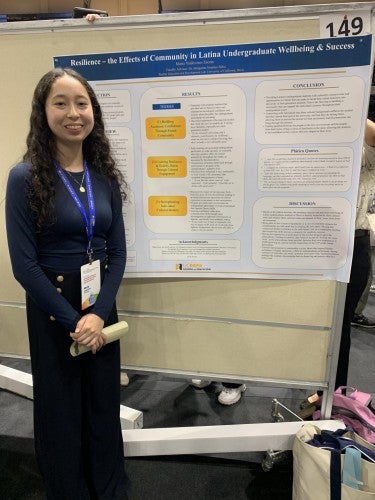 Resilience – the
Effects of Community in Latina Undergraduate Wellbeing & Success
Resilience – the
Effects of Community in Latina Undergraduate Wellbeing & Success
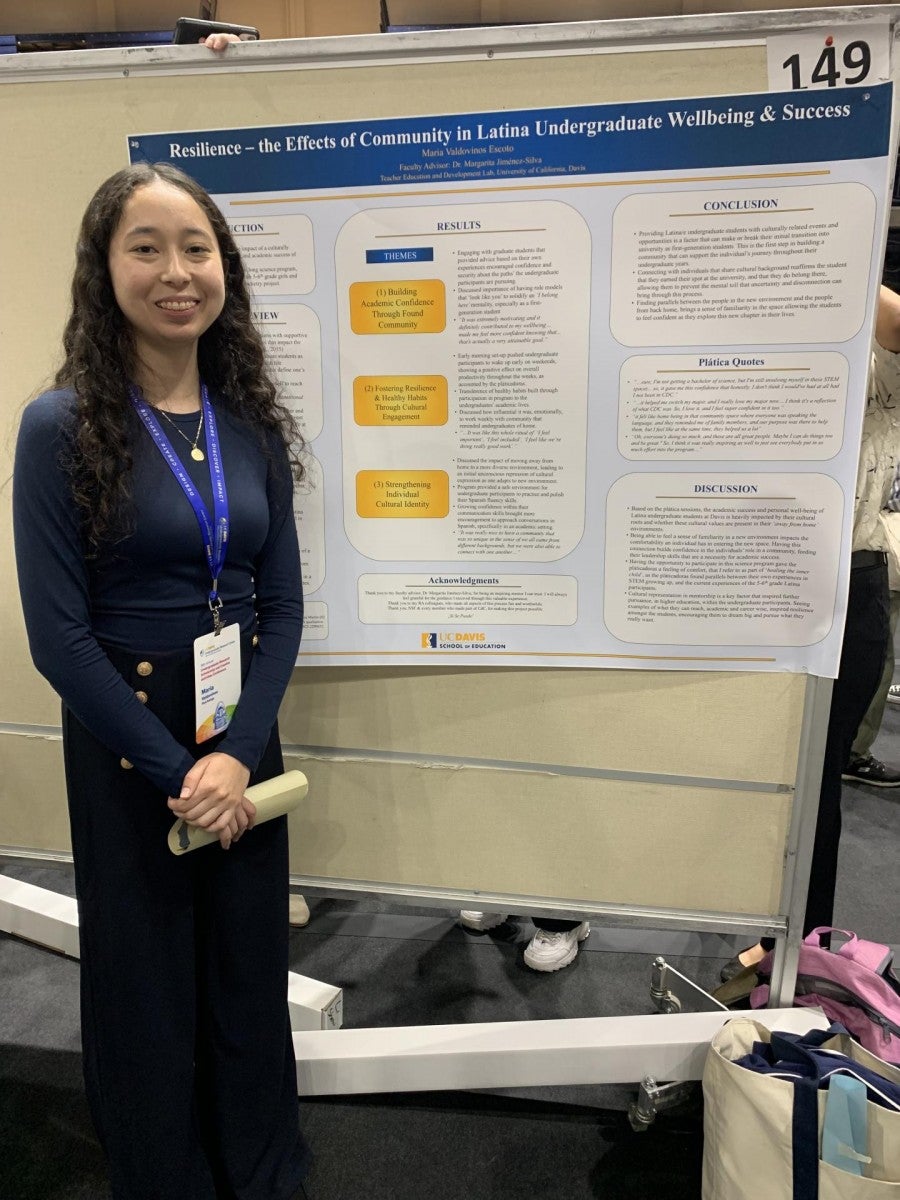
Author: Maria E. Valdovinos
Sponsor: Margarita Jimenez-Silva
Five years post-pandemic, the lingering effects on student wellness are still highly seen amongst the undergraduate Latina population. These factors contribute to the overall emotional and physical wellbeing of the student, which in turn impacts their academic success. In this study, qualitative data was collected using Plática methodology across four hour-long sessions. Participants were four Latina undergraduate students who supported 5th and 6th grade Latina girls in a culturally responsive Rocketry and Gardening science program within a local school district. Each plática session was recorded, transcribed, and analyzed using thematic analysis to gauge the impact the experience had on the participating undergraduate volunteers. The themes that emerged included building confidence in academia through a found community, the fostering of resilience and healthy personal habits through cultural engagement, and the strengthening of each individuals’ cultural identity. In summary, engaging in a culturally tied science program had an overwhelming positive impact on the participants’ overall emotional and physical wellbeing and contributed to their academic success at UC Davis.
Bridging Borders: Strategies for Enhancing Cultural and Linguistic Integration of International Students
Author: Hiu Nam Hallie Wong
Sponsor: Margarita Jimenez-Silva
This study explored how to better support international students
in learning English and adapting to U.S. culture. The study
focused on undergraduate international students at UC Davis who
completed at least one full academic year and for whom English is
an additional language. Data was collected through surveys and
focus groups to identify the key supports these students find
valuable as they develop their English proficiency and navigate
cultural challenges. Participants shared insights into the
supports that have positively impacted their experience at UC
Davis, as well as the challenges they have encountered.
Descriptive survey data is presented as well as a thematic
analysis of the qualitative data. By understanding these
experiences, the study identified patterns and trends that may be
unique to international students. The findings informed
recommendations for UC Davis staff and faculty to enhance support
for international students, fostering a more inclusive and
supportive environment that promotes both academic and personal
growth.
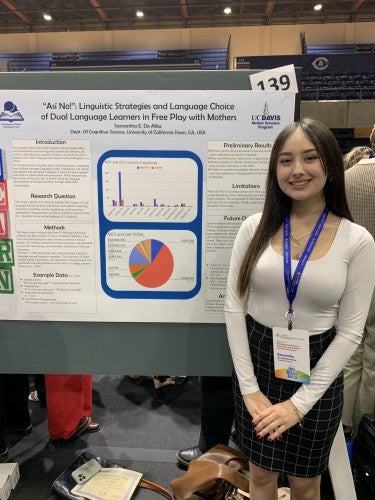 “Así No!”:
Linguistic Strategies and Language Choice of Dual Language
Learners in Free Play with Mothers
“Así No!”:
Linguistic Strategies and Language Choice of Dual Language
Learners in Free Play with Mothers

Author: Samantha De Alba Sanchez
Sponsor: Yuuko Uchikoshi Tonkovich
Children develop linguistic skills through interactive activities
like reading and play. Considering the cognitive and social
benefits of bilingualism, research on dual language learners
(DLLs) is expanding. While previous studies have examined
bilingual children’s use of questions in play, less is known
about the linguistic strategies they employ to negotiate roles,
guide actions, and express agreement. This study explores how
Spanish-English DLLs (ages 3-5) use language during free play
with blocks and a parent. We analyze strategies for guiding
actions, negotiating, and expressing agreement or disagreement,
as well as children’s choice of first (L1, Spanish) versus second
language (L2, English). Fifty-five Mexican-American children and
their mothers living in northern California were recorded during
free play at home to ensure a natural setting. Video recordings
were transcribed and coded for language use and linguistic
strategies. The frequency of child guided action, negotiation,
and agreement or disagreement was quantified and analyzed. These
findings will provide insight into how children use language in
play, helping parents reduce conflicts, foster bilingual
development, and overall enhance parent-child communication. More
broadly, given the benefits of bilingualism, examining how
children navigate dual languages in daily interactions can inform
educational and parenting strategies to maximize these benefits.
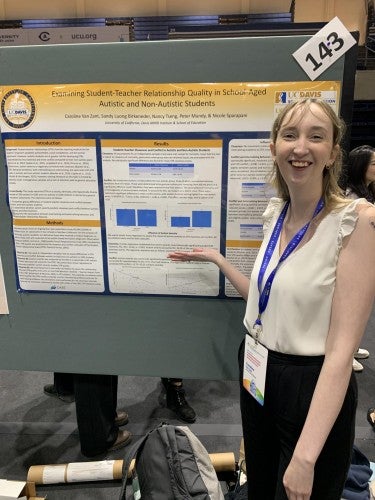 Examining
Student-Teacher Relationship Quality in School-Aged Students With
and Without Autism
Examining
Student-Teacher Relationship Quality in School-Aged Students With
and Without Autism
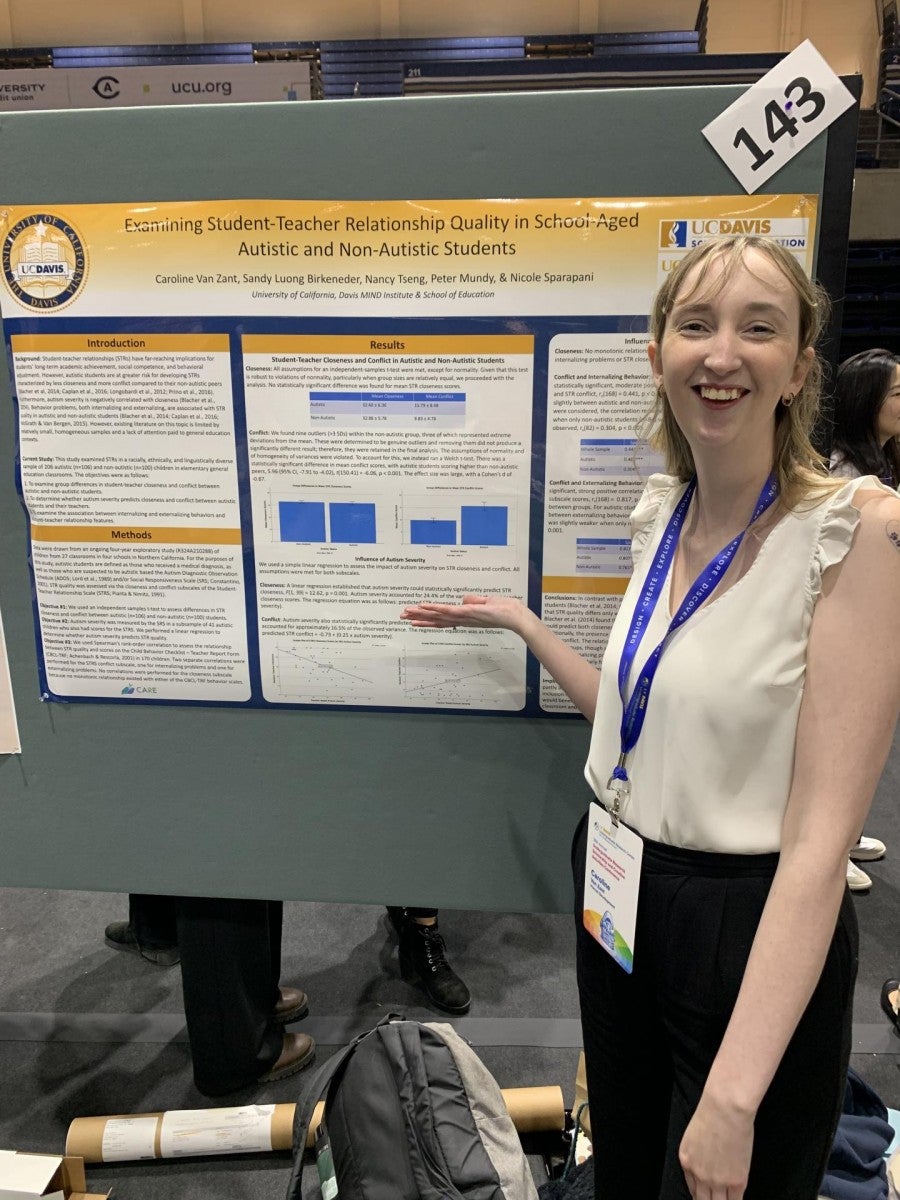
Author: Caroline Van Zant
Sponsor: Nicole Sparapani
Compared to neurotypical peers, autistic students tend to develop
lower-quality student-teacher relationships (STRs), jeopardizing
their long-term academic and social development. However,
existing literature on this topic is limited by relatively small,
homogeneous samples and a lack of attention paid to general
education contexts. This study examined STRs in a racially,
ethnically, and linguistically diverse sample of 206 autistic and
non-autistic children in elementary general education classrooms.
STR quality, child behavior problems, and autism severity were
measured by the Student-Teacher Relationship Scale (STRS), Child
Behavior Checklist (CBCL) and Social Responsiveness Scale (SRS),
respectively. Results indicate that autistic students have more
conflictual STRs than their typically developing peers. Conflict
in STRs is strongly correlated with externalizing behavior
problems, with a slightly weaker link to internalizing problems.
Unlike conflict, STR closeness was not significantly impacted by
the presence of autism or behavior problems. Autism severity had
a moderate effect on STR conflict and closeness.