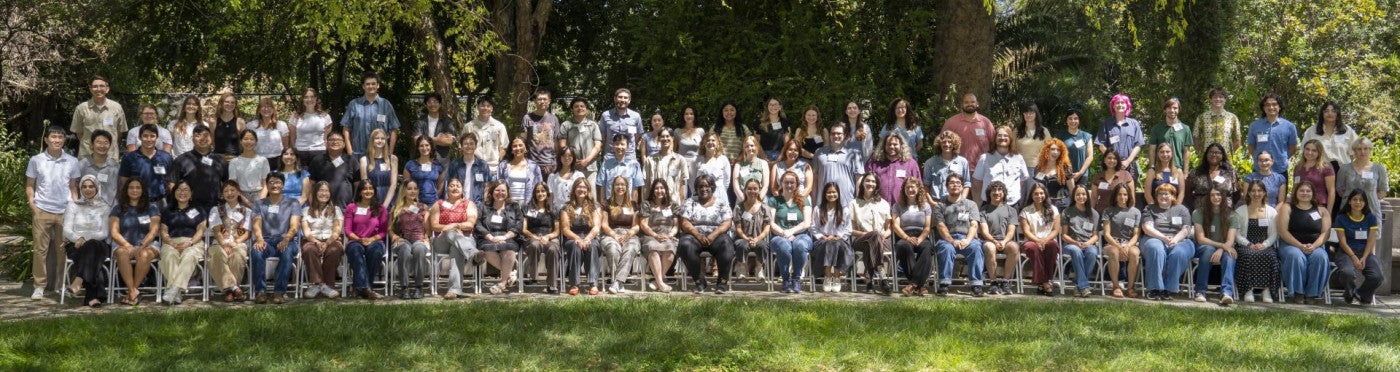
Welcome to the UC Davis Teacher Education Program
We prepare teacher leaders who have a profound impact in the
classroom and beyond, and our graduates are some of the most
sought-after teachers in the region. Our rigorous program rests
on four pillars of collaboration, advocacy for equity, inquiry
and reflection.
We offer a four-quarter combined Master of Education and teaching
credential program. Students in our program can earn a multiple subject credential,
single subject credentials in agriculture/agriculture specialist,
English, math, science, and social science, and bilingual authorizations in
Spanish and Mandarin.
In addition to the information below, you can visit the Apply
section of our website for information on how to
apply, prerequisites,
completing the online
application, and fees/financial
aid. Our Student Services staff is also available to assist
you at eduadvising@ucdavis.edu or (530) 752-5887.
Becoming a Teacher in California
What is a teaching credential, and do I need one to become a
teacher in California?
Everyone who teaches grades K–12 in California public schools on
a permanent basis is required to hold a California teaching
credential. A teaching credential authorizes you to provide
instruction in a K–12 public school and is issued under the
guidelines of the California Commission on Teacher Credentialing
(CTC).
In California, the CTC sets the preparation standards and
formally issues teaching credentials. The training and
verification are conducted by an approved program, such as a
university teacher education program like that at UC Davis. That
program formally submits a credential recommendation for the
student once they have met all the program requirements.
Do I need a master’s degree to become a teacher in California?
A master’s degree is an academic degree awarded by a college or
university. Although you must have a teaching credential, you do
not need a master’s degree to become a teacher in California.
However, teachers are often paid a higher salary for having a
master’s degree. Students in the UC Davis M.Ed./Credential
Program earn both in the same year.
Do I need to major in education if I want to become a teacher?
There is no specific major required to become a
teacher—applicants from all majors are welcome. If your
undergraduate major is not in the subject area you wish to
teach—for example, if you want to teach science but your
bachelor’s degree is in English—you will need to meet the subject
matter requirement by passing the California Subject Examinations
for Teachers (CSET) or completing applicable coursework prior to
applying.
Is a minor in education helpful?
A minor in education is not required, but may be helpful.
The UC Davis minor in education
allows you to complete prerequisite coursework for our Teacher
Education program and gain classroom experience while developing
a critical understanding of the complexities that shape the field
of education.
What is the difference between a multiple subject teaching
credential and a single subject teaching credential? Which one do
I need?
Multiple Subject credential: If you want to
teach in elementary schools, you will need a multiple subject
teaching credential. Most multiple subject teachers in California
teach in grades K–6. A multiple subject teaching credential
authorizes you to provide instruction in all subjects in a
self-contained class for students in grades twelve and below,
including preschool, and in classes organized primarily for
adults.
Single Subject credential: If you want to teach
in middle, junior, or high schools, also called secondary
schools, you will need a single subject teaching credential in
your specific subject. Most single subject teachers in California
teach in grades 7–12. This credential authorizes you to provide
instruction in only that subject to students in grades twelve and
below, including preschool, and in classes organized primarily
for adults.
What is a bilingual authorization?
A Bilingual Authorization (BILA) allows teachers to teach
academic subjects in a language other than English, such as
Spanish or Mandarin, in bilingual and dual-language immersion
classrooms. It also authorizes teachers to provide English
Language Development (ELD) and primary language instruction to
English learners. A Bilingual Authorization is not a teaching
credential on its own; it is an additional authorization earned
alongside or after a multiple subject, or single subject teaching
credential. Teachers who hold a bilingual authorization are in
great demand in California public schools.
Can I earn more than one credential?
It is possible to become authorized to teach more than one
subject. Credential candidates can earn a Subject Matter
Authorization or Supplementary Authorization based on their
undergraduate major/coursework. Candidates can also earn a second
credential by meeting the Subject Matter Requirement for the
additional subject you are interested in and taking a methodology
class. Our Credential Analyst can provide guidance on how to add
additional authorizations based on testing or coursework
completed.
What does the term “credential candidate” mean?
Credential candidates are students preparing to earn a California
teaching credential.
Why should I choose a career as a teacher?
In addition to being a fulfilling career in which you’re making a
difference in children’s lives every day, teaching is a practical
option that requires only 1-2 years of additional preparation
after you earn your bachelor’s degree. The job market for
teachers is strong.
The most recent figures from the California Commission on Teacher
Credentialing show that in 2023, over 22,000 teaching
positions were unfilled in California and 47,000 were filled with
teachers who did not have full credentials, such as those with
emergency permits. Starting
salaries in the state average $57,000 to $62,000, depending on
district size. Teachers with a master’s degree often begin in
a higher salary column or receive a salary stipend, although the
amount varies by school district and salary schedule.
Are my M.Ed. and teaching credential useful even if I later
decide not to teach?
Yes. An M.Ed. and the preparation you complete for a teaching
credential develop skills that are valuable well beyond the
classroom, including designing learning experiences,
communicating complex ideas clearly, assessing outcomes,
collaborating with diverse communities, and managing projects.
These skills can transfer to fields such as corporate training,
learning and development, human resources, educational
technology, nonprofit and government agencies, and publishing and
communications.
About the UC Davis M.Ed./Credential Program
How long does it take to earn the M.Ed. and teaching credential?
Credential candidates in the UC Davis Teacher Education Program
earn both their M.Ed. and teaching credential in four
quarters—summer, fall, winter and spring.
How many units is the program?
The M.Ed. and teaching credential curriculum combines 42–44 units
of coursework with 15 units of fieldwork, totaling 57–59 units,
depending on credential type. The M.Ed. component makes up 36
units, including a three-course series supporting teacher inquiry
and a capstone project that provides the basis of the
comprehensive exam.
Will I learn alongside the same group of students throughout the
program?
The UC Davis Teacher Education Program uses a content-specific,
yearlong cohort model designed to foster collaboration, community
building, and professional growth. Within each cohort, candidates
are matched with a Teacher Education Program Supervisor who
provides individualized guidance, mentorship, and support
throughout the program. Candidates engage in coursework,
projects, discussions, and collaborative learning experiences
with their cohort peers.
Students typically take their content-specific methodology
courses with their cohorts, while courses addressing broader
aspects of teaching and learning may bring together candidates
from multiple cohorts. Reflecting the collaborative nature of the
teaching profession, the cohort model provides opportunities for
candidates to learn with and from their peers as they develop
their instructional practice and professional identity.
When do classes and student teaching placements start?
The 2027–28 program starts July 19, 2027, and credential
candidates will begin their K–12 classroom placements within the
first month.
Does UC Davis have a part-time program, night program, or remote
program?
Our credential program is a full-time in-person program that
requires student teaching during the day and taking classes in
the afternoons and evenings.
What credentials and authorizations does UC Davis offer?
UC Davis offers the following credentials and authorizations:
What is the difference between an M.A. in Education and an M.Ed.?
A Master of Arts (M.A.) in Education emphasizes
educational theory, research methods, learning psychology, and
instructional depth. It often requires a comprehensive research
paper or thesis.
A Master of Education (M.Ed.) emphasizes applying
educational research and theory to real-world practice. It
prepares educators to strengthen their teaching, respond to
students’ needs, collaborate with colleagues and families, and
develop as teacher leaders.
As of 2027, the UC Davis Teacher Education Program offers a
Master of Education degree, replacing our previous Master of Arts
degree in Education.
Will I also be able to work a separate job during my
M.Ed./credential year?
Most students don’t find it feasible to work while attending this
program. You will spend your mornings in your school placements
and afternoons and evenings on campus taking courses.
How does UC Davis help graduates find their first teaching job?
During your program year we offer Job Search Assistance for Teachers
services, which culminate in a teacher job fair for UC Davis
candidates and alumni only. Our graduates are highly sought-after
by regional school districts, and many candidates receive job
offers at the event. Over 90% of our candidates secure their
first teaching position before graduation.
Your M.Ed. and Credential Year
How do coursework and student teaching work together?
Coursework and student teaching occur simultaneously and form a
continuous cycle in which candidates apply what they learn in
classrooms, reflect on their practice, receive feedback from
instructors and mentors, and collaborate with peers. All of our
supervisors are also instructors for cohort-specific courses,
giving candidates a deeper opportunity to connect what they are
learning in coursework with what they are observing and
practicing in their student teaching placements. They can bring
questions and experiences from their placements directly into
course discussions with their supervisor and peers.
What happens in a student teaching placement?
Student teaching is an essential experience that bridges theory
and practice. Occurring concurrently with university coursework,
student teaching (also referred to as clinical practice or field
experience) allows candidates to apply what they are learning,
develop instructional skills, and gradually assume increasing
responsibility in the classroom with the guidance of experienced
educators. The California Commission on Teacher Credentialing
requires that candidates complete a minimum of 600 hours of
clinical practice in order to qualify for a teaching credential.
Candidates are placed in K–12 classrooms with experienced
resident teachers who serve as mentors and collaborators
throughout the student teaching experience. Resident
teachers—also called mentor teachers or cooperating teachers—are
experienced educators who provide guidance, feedback, and
collaborative practice. Candidates learn by observing,
collaborating, practicing, reflecting, and receiving feedback as
they develop their instructional skills and professional judgment
in real classroom settings.
In addition to your resident teacher, you will have a UC Davis
Teacher Education Program Supervisor who provides individualized
guidance, mentorship, and support throughout your program.
Will I teach in more than one classroom during the program?
All candidates have a primary student teaching experience that
spans the entire K–12 academic year. During the first four to six
weeks, candidates observe and collaborate with their resident
teacher(s) while progressively increasing their instructional
responsibilities. By the end of the primary placement, candidates
should be prepared to lead instruction on a daily basis,
including planning lessons and supporting the implementation of
the school’s curriculum.
All candidates also have a secondary short-term placement, with
the exception of the Single Subject Agriculture cohort. The
secondary placement offers experiences in teaching in different
settings and grade levels, and the schedule varies by cohort.
Where are student teachers placed?
Most student teaching is done in school districts and charter
schools within a 45-minute drive from the UC Davis campus,
including: Davis, Dixon, Elk Grove, Fairfield-Suisun,
Folsom-Cordova, Language Academy of Sacramento, Natomas, Natomas
Charter, Robla, Sacramento City, San Juan, Travis, Twin Rivers,
Vacaville, Washington, Winters, and Woodland.
How are the resident teachers chosen?
Resident teachers are selected based on demonstrated exemplary
teaching practice, a minimum of three years of teaching
experience, and a commitment to mentoring teacher candidates.
Resident teachers partner with candidates and Teacher Education
Program Supervisors throughout the clinical practice experience
to support growth, reflection, and increasing
responsibility.