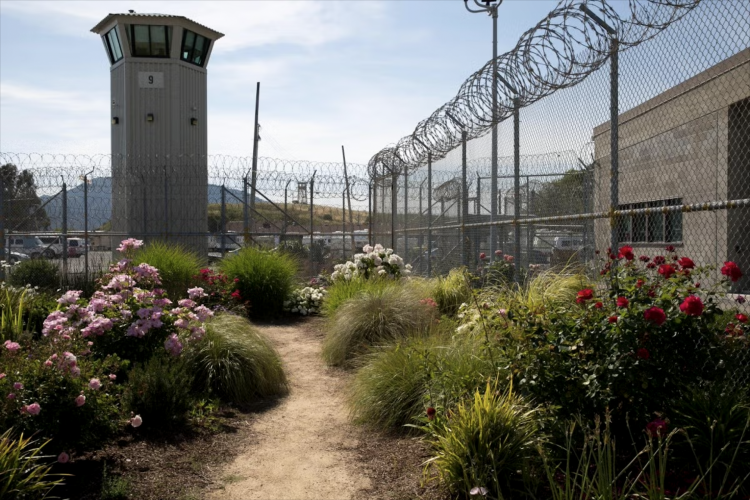
 When incarcerated participants began monitoring birds from a prison yard, the natural world started looking and feeling different. “For years I had been referring to Rock Doves as ‘pigeons,’” said Omar Dent, III. “Little did I know that these pigeons’ true names are Rock Doves and that they are actually a part of the dove family. The picture that formulates in my mind when I think about doves are beauty, majesty, and purity. I viewed the Rock Doves as being pests. But I’m realizing now, the way you perceive a thing assigns its value to you.”
For Dent and his peers at the California Health Care Facility in Stockton, bird watching is more than observation. It’s an opportunity to contribute data to the science field. Through citizen science activities developed by Land Together and the Center for Community and Citizen Science (CCCS), the bird watchers supported hands-on, inquiry-driven projects designed specifically for incarcerated spaces.
This kind of learning fosters more than knowledge. It builds confidence, cultivates expertise, and reconnects people to a sense of purpose and community. As project leaders Heidi Ballard, Laci Gerhart, and Ryan Meyer explain, “Developing science knowledge fosters marketable skill sets and empowers participants to address environmental challenges in their communities.”
A Field Guide By and For Imprisoned People
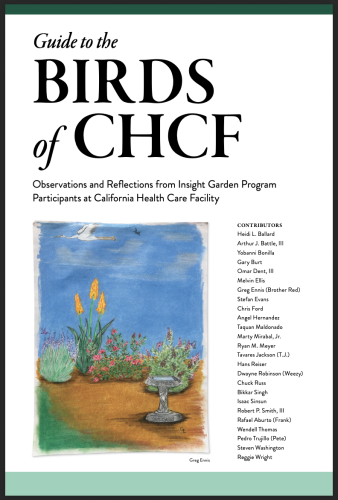 While published bird guides can be useful for learning, they don’t often take a birder’s context into consideration—a reality that can alienate readers in incarcerated spaces. To address this gap, birding participants co-authored a field guide for other imprisoned individuals. The guide offers identification tips, region-specific observations, reflections, and artwork, showing that learning, creativity, and contribution can occur in highly constrained environments.
Now, in partnership with Land Together and CCCS, the co-authors seek to distribute the guide to other prisons and their home communities. Their goal is to expand ideas about who gets to contribute to science and to prepare individuals from marginalized communities to address environmental challenges in their daily lives.
Expanding Access to Science and Learning
Gifts to the Science Inside Projects Fund will help print and distribute bird guides to people in prison and their home communities, expanding access to education and environmental engagement and broadening perspectives on who can participate in science.
The Science Inside Projects Fund will also support ongoing creative and scientific projects developed by people who are incarcerated. Contributions to this effort will help strengthen programming in prisons that:
- Builds scientific knowledge and transferable skills
- Fosters curiosity, confidence, and lifelong learning
- Cultivates connections to community and the natural world
- Enriches the broader field of citizen science
If you would like to receive additional one or more copies of the bird guide, please contact Ryan Meyer (rmmeyer@ucdavis.edu) for more information. A recommended minimum donation of $30 per copy covers printing and postage. CCCS will also send a second book to an incarcerated person.